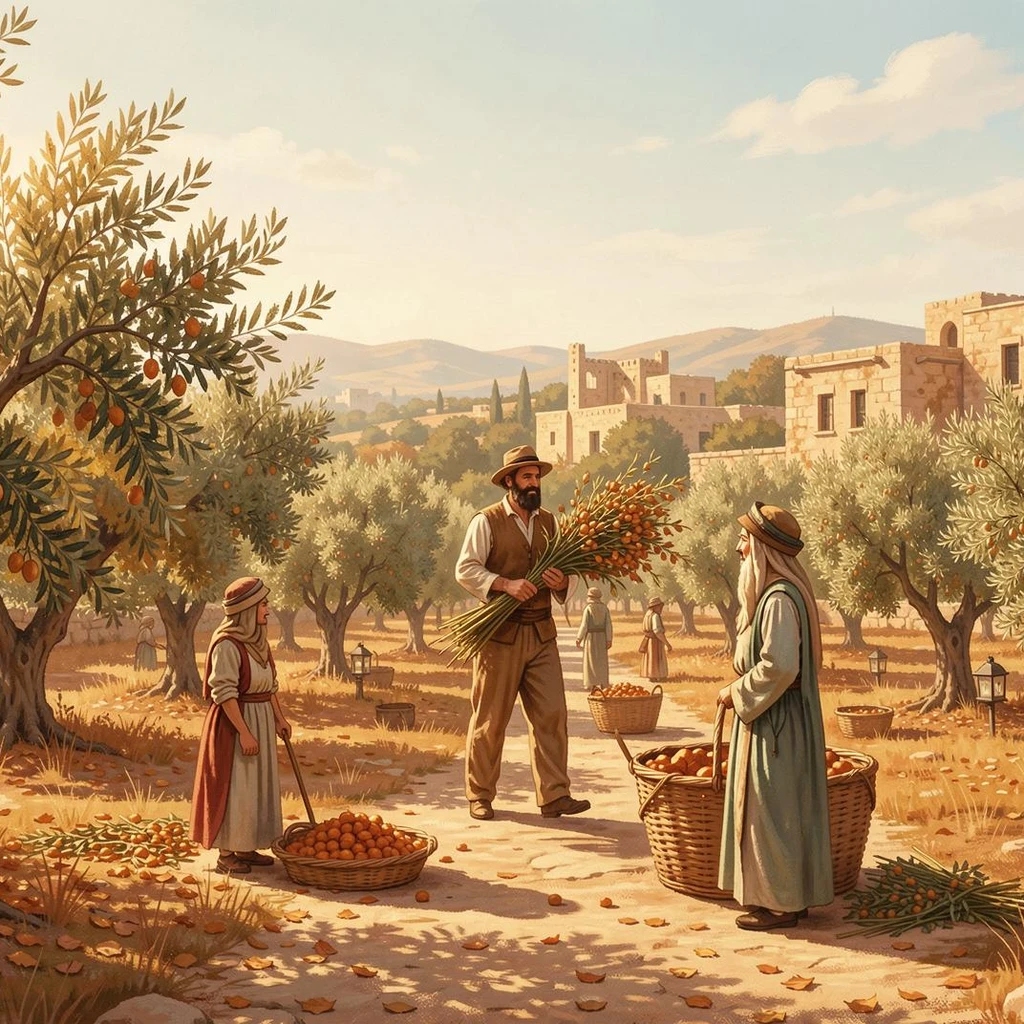
CHAPTER 15 — OCTOBER 2035: OLIVE GROVE MEETING
One
October 2035. The harvest had begun.
Nets were spread beneath the olive trees—white fabric catching the falling fruit, the olives dropping with the wind and the passing days. The pickers would come next week, but the first olives had already fallen, scattered across the nets like dark coins.
Tayeb walked the grove at dawn, checking the nets, counting what the winter storms had spared and what the autumn harvest would bring.
The branches that had broken in February had been pruned away. The grafts that Yassin and Omar and Sami had prepared—six of the twelve had taken, six new saplings growing in the courtyard, their leaves green, their roots establishing in the clay soil.
He reached Row Seven, Tree Twelve—the tree that had lost its branch in the storm, the tree whose scion now grew in a pot in the courtyard, the bark closing around the break like a hand over a wound.
The net beneath the tree was filling with olives.
Karim had called on Tuesday. His voice on the phone had been unfamiliar at first—deeper, rougher than Tayeb remembered. Forty-five years since Atlanta. Thirty since they had last spoken. I have things I need to bring you, Karim had said. Records. Delivery logs. Thirty-nine years.
Come, Tayeb had said. The harvest is starting.
The taxi arrived at 9:17.
Tayeb heard it before he saw it—the engine straining against the rutted road from the highway, the tires crunching over gravel, the dust rising above the olive rows. He walked toward the courtyard as the taxi pulled through the gate.
The driver opened the door. An old man stepped out—seventy, white hair, stooped shoulders, clothes worn but clean. He carried a small leather bag, nothing else. He paid the driver, the transaction brief, the taxi turning back toward Tunis.
The old man turned. He saw Tayeb standing in the courtyard entrance.
They looked at each other across the space. Tayeb had been seven the last time they had played in this grove together. Karim had been nine. Now they were sixty-nine and seventy, both gray, both worn by the decades.
“Tayeb,” Karim said.
“Karim.”
No surname. No introduction. Just the names they had called each other as boys.
Karim walked toward him. His gait was uneven—one hip stiff, his weight shifting with each step. He stopped an arm’s length away.
“You got old,” Karim said.
“You got older.”
Karim almost smiled. His eyes moved past Tayeb to the courtyard, the saplings along the southern wall, the olive trees beyond the gate.
“You’re actually here,” Karim said. “Forty-five years. I thought you’d die in Atlanta.”
“I almost did,” Tayeb said.
They stood in the courtyard entrance. The wind moved through the saplings, their leaves stirring.
“May I see the grove?” Karim asked.
“After you,” Tayeb said. “Slower, if you don’t mind.”
“I was going to say the same.”
Two
They walked through the courtyard gate, into the olive rows, into the autumn light.
The ground was uneven. Tayeb’s left knee clicked—a sharp sound that carried in the quiet. Karim’s breathing grew audible after fifty paces, a slight wheeze that he tried to suppress.
Karim stopped. He leaned against a tree, pressing his hand to his side.
“The road from Tunis was longer than I remembered,” he said.
“The grove was smaller when we were young,” Tayeb said. “Or perhaps we were faster.”
“My doctor tells me to walk. Thirty minutes a day.” Karim pushed off the tree. “He doesn’t mention olives underfoot.”
They moved deeper into the grove. Karim stopped at Row Seven, reached out, touched the bark of Tree Twelve—the one with the healed wound.
“Some of these were here when we were children,” Tayeb said. “Planted by my great-grandfather in the eighteen-eighties. My grandfather added more. The new ones are grafts—Yassin’s work. One of the young men.”
“The grafts.” Karim examined the ridge of new bark where the branch had broken. “Six of twelve took, you said on the phone.”
“Six took.”
Karim ran his thumb along the ridge. “The cambium matched.”
“Yassin found the technique in an old agricultural manual. He’s been practicing on fallen branches.”
They stood beside the tree. The olives dropped onto the net—soft thuds, one after another, the rhythm of the harvest.
“The maternity ward was decommissioned in January 2030,” Karim said. His voice was flat. “I was sixty-five. They converted the space for General Surgery. More efficient utilization, they said.” He looked at the olives scattered across the net. “The cribs were already gone by then. Stacked in a storage room on the third floor.”
He pressed his palm flat against the bark.
“I kept the logs,” he said. “Every delivery. Every name. Thirty-nine years. In January 1987, I was still in medical school—I delivered my first baby that year. Thirty-four births in that single month at the ward. In January 2026, the year I retired, there were three.”
The wind moved through the grove. An olive fell from the branch above them and landed on the net between their feet.
“The smell,” Karim said. “That’s what stays. A full ward smelled of milk and sweat and antiseptic and blood—the metallic tang of it—and something underneath. Something you could almost taste.” He paused. “One year at a time, that smell faded. By the end there was only disinfectant. Clean. Empty.”
He looked at Tayeb.
“The lights went out section by section,” he said. “Ward by ward. Floor by floor. By 2020, half the ward was dark. By 2024, three-quarters. I would walk through the dark sections at night, checking empty rooms. The cribs in the corner. The monitors unplugged. The silence.”
His hand trembled against the bark. He pressed harder, steadying it.
“I watched every number between those two,” he said. “One delivery at a time. One year at a time. I thought it was about the births. I thought if the births came back, everything would recover.”
He looked at the olives on the net. The fruit lay scattered, dark and heavy, the harvest filling the fabric.
“I was wrong,” he said.
Three
They reached the southern edge of the grove, where the family plot stood beneath the carob tree.
Four graves. Four generations.
Karim stopped. He read the names on the stones.
“Your father,” he said. “1928 to 1998.”
“He was the bridge,” Tayeb said. “He received the transmission intact. He watched the dismantling. He tried to recover what was lost. He couldn’t.”
Karim was quiet. He looked at the graves, the dates, the names carved in limestone.
“My father died in 2005,” Karim said. “Hassen. Ministry of Education. He believed in the state. He believed the new way was better.” He paused. “He voted for the party. He supported the policies that dismantled the zawiyas, the waqf, the networks. He thought he was building modern Tunisia.”
He looked at Tayeb.
“He sent me to medical school at the University of Tunis. He told me I was going to be part of the future.” Karim’s hand rested on the carob tree’s bark. “He never saw the cribs stacked empty. He never saw the ward go dark. He died believing he had built something.”
“Our fathers,” Tayeb said. “Both of them. They implemented it. They believed in it.”
“Yes.”
“My father lived long enough to see what was lost,” Tayeb said. “He tried to restore the networks. The institutions. The transmission. But the foundation was gone. He couldn’t rebuild what no longer existed.”
Karim touched the carob tree. His fingers were weathered, spotted—the hands that had caught thousands of babies, that had unwrapped cords from around necks, that had placed newborns on their mothers’ chests.
“Do you remember what our grandfather told us?” Karim asked. “In the zawiya. 1972. I was seven. The circle of men. The sheikh’s hand on the shoulder.”
“I was five,” Tayeb said. “I don’t remember the zawiya. I remember the grove. I remember him pointing at the oldest tree and saying—”
“Everything important is transmitted hand to hand,” Karim said. “Shoulder to shoulder. When the circle breaks, the transmission stops.”
They stood beside the graves. The wind moved through the carob tree, the leaves rustling above them.
Four
They walked back toward the farmhouse as the afternoon wore on. The October light turned golden, slanting through the rows, the shadows stretching long across the ground.
Tayeb told Karim about the recovery project—the first circles, the growth, the state’s offer, the conditions. The division that followed. The collapse.
Karim listened. He asked few questions. When Tayeb described the state’s offer—the funding, the registration, the requirement to submit member lists—Karim’s jaw tightened. When Tayeb described the collapse—the accusations, the desertions, the three young men who stayed—Karim’s hand went to his leather bag, gripping the strap.
“The three young men,” Karim said. “They stayed.”
“Yassin, Omar, Sami. They stayed. They found the old manuals. They learned the grafting. They kept practicing after everything else fell apart.”
“Without the old networks. Without the zawiyas. Without the transmission.”
“The zawiyas are boarded,” Tayeb said. “The institutions are abolished. The transmission was broken before they were born. They grew up with nothing.”
“And yet they learned.”
“They learned. Not restoration. The old scion on new rootstock. Yassin’s words. The cambium matching, the wound closing, the tree surviving in a different form.”
Karim stopped walking. The rows stretched in every direction around them, the nets spread beneath the branches, the olives dark against the white fabric.
“In Indonesia,” Tayeb said, “I saw networks that survived. Not by resisting. By accommodating. The pesantren preserved the dhikr, the circle, the transmission—while accepting the state’s logic on family size. The institution survived. The fertility collapsed anyway.”
He looked at Karim.
“But the mechanism—the way of being together, the way of transmitting—something in it endured. Even when the content changed. Even when the numbers fell.”
Karim said nothing. He looked at the trees around them.
He looked toward the base of the oldest tree, the one Tayeb’s great-grandfather had planted in the eighteen-eighties. Something green grew there—a shoot, no thicker than a finger, pushing up through the cracked earth where two roots broke the surface. New leaves, silver-soft, catching the afternoon light.
Karim walked toward it. He knelt—one hand on the trunk for balance, his knees cracking as they met the ground. He leaned close. His fingers hovered above the shoot without touching it.
He looked up at Tayeb.
“How long?” he asked.
“I found it in February. After the storms. The branch had broken and the wound was fresh and this was growing at the base.”
Karim straightened. His knees protested. He placed his palm flat against the trunk of the oldest tree.
“The trees stand together,” he said. “The roots connect beneath the soil.”
“The tree endures what the branch cannot,” Tayeb said. It was their grandfather’s saying. Both of them had grown up with it.
Karim looked at him.
“You remember.”
“I remember.”
They stood in the grove, the olives dropping around them, the October light turning amber.
Five
The sun began to sink toward the horizon. They sat on the stone bench at the edge of the grove—the same bench where Tayeb’s grandfather had rested, where his father had sat, where three generations had watched the olive trees endure.
Karim reached into his leather bag. He removed a book—bound in brown leather, worn, the pages yellowed at the edges.
“The logs,” he said. “Not all of them. Just the names. The births. From 1987.”
He opened the book. The pages were filled with handwriting—neat, precise, the names listed by date, by mother, by baby, by time of birth.
Tayeb looked at the pages. January 1987: twenty-eight births. February: thirty-one. March: twenty-nine. Row after row, page after page, the names of mothers and children, the dates and times, the weights and measurements. Each name a birth. Each birth a pair of hands receiving a body into the world.
Karim turned the pages. The entries continued—steady through the late eighties, beginning to thin in the mid-nineties, thinning further each year. By 2017 the pages were sparse. By 2026, a handful of names per month.
He pointed to an entry. “March 1987. A boy. The cord was wrapped around his neck. I unwrapped it. He breathed.”
He turned more pages. The names continued, each one a life, each one a record of something that had happened in a room that no longer existed.
Karim closed the book. He held it for a moment—the weight of it in his hands, the leather warm from his palm.
“I want you to have it,” he said.
He held it out. Tayeb took it. The leather was worn smooth, the pages soft, the names preserved in faded blue ink.
“The logs are heavy,” Karim said. “Some nights I would take them out and read the names. Fatima. Ahmed. Samira. Youssef. Aisha. I would wonder where they are now. Whether they have children. Whether they remember their own births.”
He looked at his hands—weathered, spotted, the hands that had unwrapped cords and caught slippery bodies and placed newborns on their mothers’ chests.
“I carried them for thirty-nine years,” he said. “Now you carry them.”
Tayeb held the book. The leather pressed warm against his palms. He turned to a page at random. August 1993. Fourteen births. The handwriting was younger then—Karim’s script more upright, more confident. Each entry recorded the hour, the weight, the mother’s name, the child’s name. A column for complications. Most were blank.
Six
The sun sank below the horizon. The afterglow held—a deep blue in the western sky, the olive trees darkening to silhouettes against it.
They sat on the stone bench. The book of names lay between them, open to the first page, the entries from January 1987 in faded blue ink.
The wind moved through the grove. An olive fell from a branch somewhere in the darkness—soft impact on the net, the fruit caught, the tree standing.
Karim looked toward the courtyard wall, where the six saplings stood in their pots. Green shapes in the gathering dark, their leaves catching the last of the light.
“Not the same trees,” Karim said.
“No,” Tayeb said. “Not the same trees.”
They sat together on the bench. The stars appeared one by one above the grove. The book of names lay open between them. The olives fell. The trees stood.