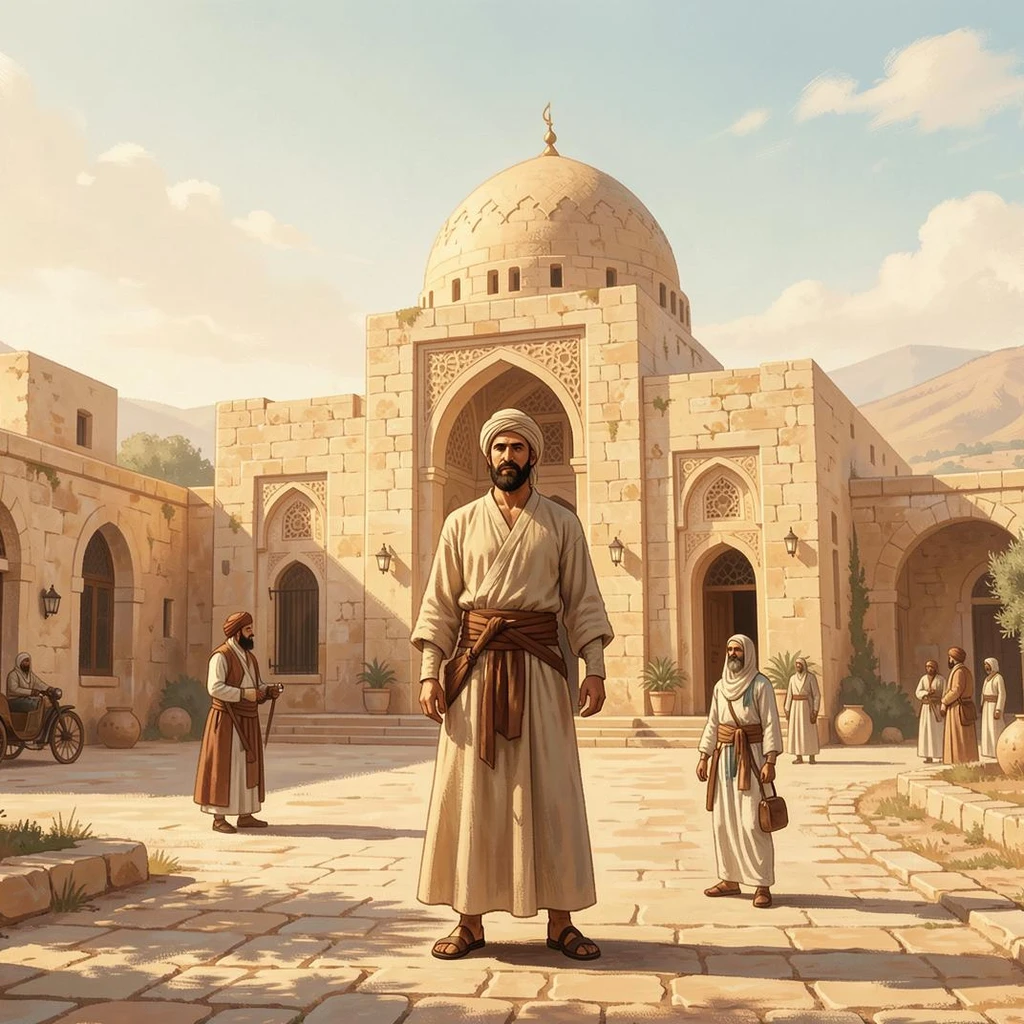
CHAPTER 6 — JANUARY 2027: RESOLUSI JIHAD MOSQUE
Surabaya, January 2027. The Resolusi Jihad Mosque occupied a corner of downtown Surabaya — white walls washed clean by the tropical rain, green dome glazed against the sun, minaret rising slender against the skyline. The entrance arch was carved with Arabic calligraphy — La hawla wa la quwwata illa billah — no strength except through God.
But unlike most mosques, this one had no ablution fountain, no prayer hall visible from the street. The main entrance led to a courtyard, and beyond the courtyard, the memorial. January rain had left the stone slick, the gutters still running with runoff, the air thick with the smell of wet concrete and exhausted drains.
Tayeb passed through the archway. The courtyard was paved with red brick — the Surabaya signature, fired from the local soil. In the center stood the memorial, a stone monument three meters high, the faces black volcanic rock, the inscriptions in gold lettering that caught the January sun.
Kyai Hasyim Asy’ari. Kyai Wahab Hasbullah. Kyai Mansur. Kyai Abdul Wahab. Dozens of names. Hundreds. Each name a kyai — a teacher, an elder, a leader of the network. Each name a man who had died defending his community from the Dutch in 1945.
The memorial was four-sided, each face covered in names. The north face listed kyai from East Java. The south face listed Central Java. The east face listed Madura. The west face listed the students, the ordinary men who had answered the fatwa and died.
Inside the monument, in a glass case built into the base, were the artifacts.
A rusted bamboo spear — the kind used by pesantren students in 1945, too poor for guns, too improvised for conventional warfare. A Dutch helmet, dented and battered, taken from a fallen soldier. A photograph, yellowed at the edges, showing Kyai Hasyim Asy’ari addressing the crowd in front of the Gresik railway station — his finger raised, his face fierce, the crowd extending to the horizon.
Another photograph: Kyai Wahab Hasbullah standing in front of the Bubutan prison, negotiating the release of Indonesian prisoners. He wore a white kupiah, a black coat, his hands clasped behind his back. The Dutch soldiers on either side held rifles, their faces tense. Wahab’s face was calm.
Tayeb studied the photographs. The weapons. The names.
He had read about the war of independence — the Dutch attempt to reclaim their colony after the Japanese surrender, the three-week battle, the thousands dead. But the photographs were here, in the glass case. The names were here, on the stone. The rusted spear was here, in his line of sight.
Resolusi Jihad. The Jihad Resolution.
Kyai Mansur appeared from the mosque entrance — sixty-five years old, Javanese, his skin the color of teak weathered by decades of tropical sun. His beard was gray, trimmed short, his hair thinning. He wore a white kopiah on his head, a white koko shirt, black trousers with a folded sarong around his waist. His hands were scarred — one across the knuckles, from an industrial accident in his youth, one from a snake bite that had nearly killed him. His eyes were dark, direct, unafraid of contact.
He moved slowly, the gait of an old man who had spent decades walking through pesantren courtyards, through village paths, through muddy rice fields. His voice was raspy, his diction precise.
“You are the visitor from Tunisia,” Kyai Mansur said.
Tayeb nodded. “Tayeb Damerji.”
“You are researching our networks.”
“Yes.”
Kyai Mansur gestured toward the memorial. “Then you must understand this. The network is not only what you have seen.”
He walked to the monument, touched the first name.
Kyai Hasyim Asy’ari. Founder of NU. Resolusi Jihad, October 22, 1945.
“My great-uncle,” Kyai Mansur said. “He issued the fatwa — the Resolusi Jihad — in October 1945. He said: fighting the infidels who attack the Muslim community is obligatory upon every believer. Individual obligation. Not collective. Every Muslim who can fight must fight.”
He paused.
“He issued the fatwa from Tebuireng. He told the people: fight. And they fought. He lived to see independence, and then he died of it — of the grief of the continued Dutch military actions, two years after the battle. The stroke took him in July 1947, when he heard news of the Dutch aggression.”
Tayeb read the names again. Hundreds of kyai. Thousands of students. The pesantren had emptied — students becoming soldiers, kyai becoming commanders, the network becoming an army.
“The British,” Tayeb said. “And the Dutch.”
“The British arrived in September 1945,” Kyai Mansur said. “They said they were accepting the Japanese surrender. They said they were disarming the Japanese. But they were not disarming the Japanese. They were disarming the Indonesians. They were restoring Dutch colonial rule. The Indonesians — we — understood this.”
He walked along the memorial, reading the names.
“In October, the British commander issued an ultimatum. Surrender your weapons by November 10, or we will attack Surabaya. The Indonesian forces — the pemuda, the youth, the freedom fighters — refused. On November 10, the British attacked. The Battle of Surabaya began.”
Tayeb knew the numbers. Three weeks. Thousands dead. The city gutted.
“The network fought,” Tayeb said.
“The network fought,” Kyai Mansur agreed. “The kyai issued the fatwa. The students answered the call. The pesantren became barracks. The mosques became command centers. The network became an army.”
He looked at Tayeb.
“Can you imagine?”
Tayeb looked at his hands — clean, soft, the hands of an engineer who worked with keyboards and touchscreens. He looked at Kyai Mansur’s hands — scarred, the knuckles thickened, the fingers bent at odd angles. Old injuries. Or not so old.
“My grandfather,” Kyai Mansur said, “was a kyai in Jombang. East Java. November 1945, the British ultimatum came: surrender your weapons by November 10, or we attack. The kyai gathered at Pesantren Tebuireng to discuss. What should we do? Some said: obey the British. Avoid bloodshed. Others said: resist. Fight for independence.”
Kyai Mansur’s hands moved as he spoke — rubbing his thumb over the scars on his knuckles, a repetitive motion, unconscious.
“My grandfather was thirty-four years old. He had a wife, three children, a pesantren of forty students. He was not a soldier. He was a teacher. But when the kyai voted to issue the fatwa — Resolusi Jihad — he went home and told his students: Those who can fight, come with me. Those who cannot, stay and pray.”
Tayeb looked away, toward the courtyard gate, the street beyond. He couldn’t picture it — couldn’t picture his grandfather, a man who had tended olive trees and recited Quran, picking up a rifle.
“Twenty-eight students went with him,” Kyai Mansur said. “My grandfather walked at the front. They had no weapons. No training. Nothing but faith and the fatwa in their pockets. They walked south toward the Wonokromo rail junction, where the British column was advancing. They found a patrol — a dozen soldiers, British Indian Army, rifles shouldered. The Indonesians attacked. Took their weapons.”
Kyai Mansur’s thumb stopped moving over his knuckles. He looked at Tayeb.
“My grandfather survived that battle. He fought for three weeks. He saw friends die. He killed men — Dutch, British, other human beings. When the British finally took Surabaya, he escaped into the countryside. Returned to his pesantren. Resumed teaching.”
Tayeb couldn’t look at him. He found himself studying the pattern of the courtyard tiles — geometric, intricate, the lines repeating and interlocking, the red brick dark with rain.
“Tunisia,” Tayeb said. “The networks had no teeth.”
Kyai Mansur nodded. His hands resumed their rubbing. “The difference is not that Indonesians are more violent than Tunisians. The difference is that the networks here — they preserved the capacity to defend themselves. Not the desire. The capacity.”
He looked at his scarred hands. “My grandfather never picked up a weapon again after 1945. But the fact that he had — the fact that the network had fought, had bled, had demonstrated the capacity for violence — that changed how the state treated the network. The state knew: the pesantren cannot be bullied without cost. The kyai cannot be pushed without resistance.”
Tayeb nodded, still looking at the tiles. His hands rested on his knees — clean, unscarred. The hands of a man who had never held a weapon, never fought, never bled for anything.
“The capacity,” Tayeb said, his voice sounding strange to his own ears. “For violence.”
“The capacity,” Kyai Mansur agreed. “Not the desire. The network prefers peace. The network prefers negotiation. The network prefers accommodation. But the network maintains the capacity — and the state knows it.”
He turned back to Tayeb. “Could the Tunisian state have destroyed the networks if the networks had fought back?”
Tayeb was quiet. In 1956, the zawiya was still open. The waqf still funded. His grandfather still alive. If they had fought…
“Maybe not,” Tayeb said. “Maybe the state would have negotiated. Maybe the networks would have preserved something.”
“But they didn’t fight,” Kyai Mansur said.
“No.”
“Why?”
Tayeb looked at his hands. His grandfather’s hands had been rough — from the olive trees, from the soil. But not from fighting. Never from fighting.
“They believed,” Tayeb said slowly, “that modernization was necessary. That independence required a unified state. That the old networks — the zawiya, the waqf, the tariqa — were obstacles to progress. They collaborated in their own dismantling. They thought they were building something better.”
“And now?”
“Now the TFR is 1.6. The population is aging. The future is uncertain.”
Kyai Mansur nodded. He walked back to the memorial, touched his grandfather’s name.
Kyai Mansur. Died November 1945.
“The network preserved the capacity to defend itself,” Kyai Mansur said. “And the network can change.”
He looked at Tayeb.
“The network has teeth.” He touched the memorial. “And patience.”
“And yet,” Tayeb said, “the fertility collapses anyway.”
“Yes.”
“So what good are teeth?” Tayeb asked. “What good is autonomy? What good is flexibility? If the outcome is the same?”
Kyai Mansur was quiet for a long moment. The courtyard was still. The city hummed beyond the walls.
“The outcome is not the same,” he said finally.
“How?”
“Because the network can change,” Kyai Mansur said. “When the evidence changes — when the TFR falls too far, when the population ages, when the demographic reality becomes clear — the network can revise its teaching. The network can say: three children is sunnah. Four children is necessary. The network can adapt.”
“And the state?”
“The state cannot change its mind.”
He paused.
“The network survived the Dutch. The Japanese. The British. Sukarno. Suharto.” He touched the memorial stone. “The network will survive this too.”
Tayeb looked at the names on the memorial. Hundreds of kyai. Hundreds of students. Names carved in volcanic stone, dark with rain, the gold lettering catching what light came through the clouds.
“If the network teaches two children is sunnah,” Tayeb said, “and the families choose two children, and the fertility collapses… then the teeth, the flexibility, the autonomy — what are they preserving? What’s the substance that survives?”
Kyai Mansur didn’t answer immediately. He walked to the mosque entrance, looked inside — prayer rugs, mihrab niche, minbar pulpit. The space was empty, waiting for the next prayer.
“The substance,” Kyai Mansur said finally, “is what passes between these names and the living.” He gestured to the memorial, then to a group of students crossing the far end of the courtyard. “From there.” He pointed to the stone. “To there.” He pointed to the students. “That is all I know.”
He touched his grandfather’s name.
“My grandfather died defending the community. He died defending the right of the community to transmit its knowledge to the next generation. He died defending the right of the network to survive.”
“And what transmits?” Tayeb asked. “Through the network? From generation to generation?”
Kyai Mansur smiled — a small thing, barely visible beneath the gray beard.
“That,” he said, “you will not find among the dead.”
He walked into the mosque. A moment later, his voice rose — not amplified, not recorded, but human, filling the courtyard.
Allahu Akbar. Allahu Akbar. Ashhadu an la ilaha illa Allah.
Tayeb stood in the courtyard, the January rain beginning — fat drops on the volcanic stone, darkening the memorial, running in channels down the carved names. The adhan echoed against the mosque walls. A student crossed the courtyard, sandals slapping on wet brick, heading toward the sound.