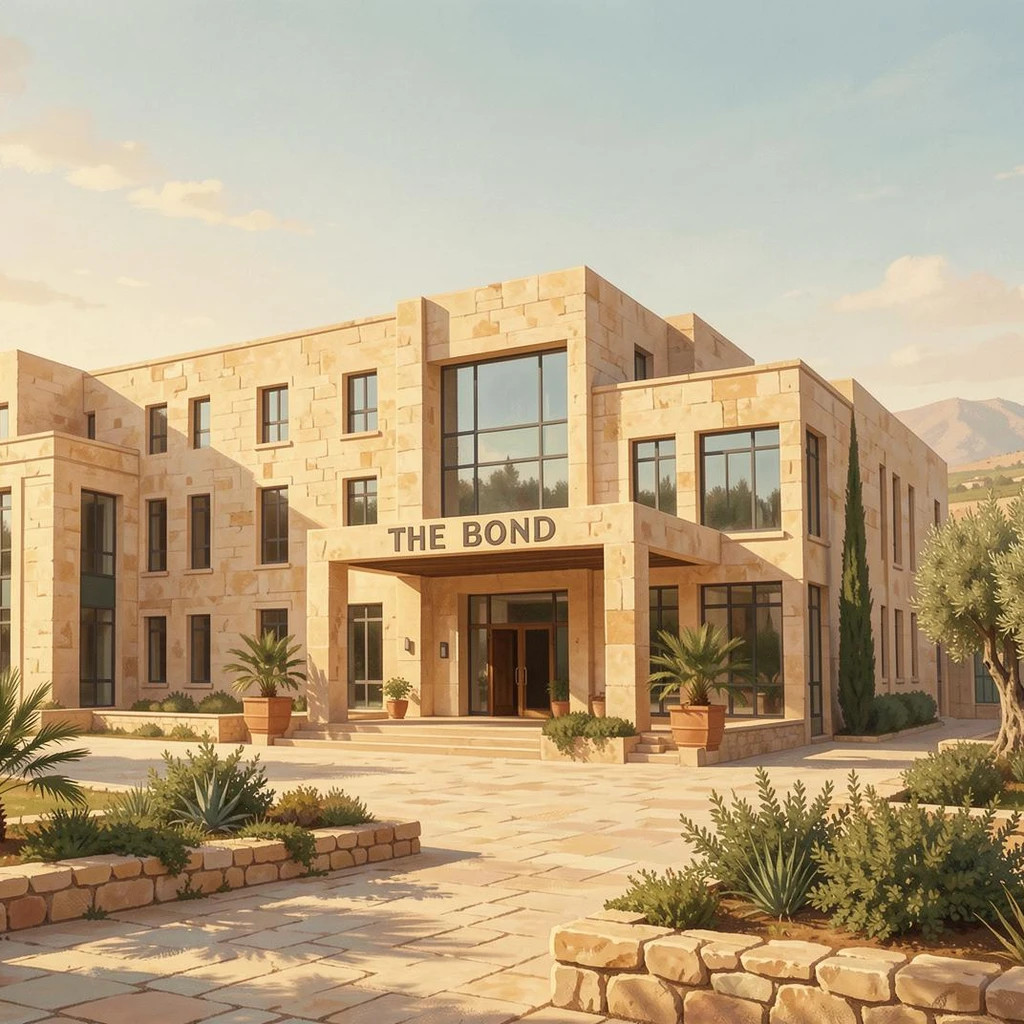
CHAPTER 16 — MARCH 2036: INSTITUTIONALIZATION
One
March 2036. Seven years since returning from Indonesia. Two years since the first recovery collapsed. One year since the three young men began grafting in the courtyard. One year since the recovery began again.
The office was no longer his dining room.
Tayeb stood at the window of the new building—three stories of glass and concrete on Avenue de la République in Tunis, overlooking the Mediterranean. The office was on the second floor, the space open-plan, desks arranged in clusters, the walls white and bare. Nine staff members worked at their desks—answering phones, responding to emails, managing the schedules, the budgets, the communications.
The sign on the building facade said: Fondation pour la Transmission des Réseaux Culturels. Foundation for the Transmission of Cultural Networks.
The name had been Yassin’s idea. “Foundation,” not “association.” “Transmission,” not “restoration.” “Cultural networks,” not “religious networks.” The language was deliberately secular, deliberately modern, deliberately acceptable to the state.
Tayeb had agreed. He had provided the funding—his atlas_bridge earnings, his savings, his investment in what the three young men had created. He had not expected this growth.
In a year, the three zawiyas had become twelve. The forty-two students had become three hundred. The practice that had continued in secret had become visible—students meeting in courtyards, in community centers, in rented spaces, learning the dhikr, studying the old manuals, practicing the grafting, the listening, the observation.
The state had noticed.
“Uncle.”
Tayeb turned from the window. Yassin stood in the doorway—twenty-six now, no longer a student, the foundation’s program director. He wore a suit, tie, the uniform of the professional class he had been born into but had tried to transcend.
“The Ministry called,” Yassin said. “Again.”
Tayeb nodded. He had been expecting this. “What do they want?”
“A meeting.” Yassin entered the office, closed the door behind him. “The Minister of Religious Affairs himself. Not an aide. Not a bureaucrat. The Minister.”
“When?”
“Tomorrow. Ten AM. Ministry headquarters.”
Tayeb looked out the window again—at the Mediterranean beyond the glass, at the city spreading inland, at the future arriving whether he wanted it or not.
“What do they want with us?” Tayeb asked.
“Recognition,” Yassin said. “Partnership. Funding. Integration into the national framework for religious associations.”
He paused. “They’re offering three million dinars. Annual funding. For the foundation. For the zawiyas. For the students.”
Tayeb turned the pen between his fingers.
“They’re also offering something else,” Yassin said. “Legal recognition. The zawiyas would be registered as religious associations under the Ministry. Protected by law. Funded by the state. Integrated into the national system.”
Tayeb turned from the window. “What do you think?”
“I think,” Yassin said slowly, “that this is what we’ve been working toward. Recognition. Resources. The ability to scale beyond what private funding can support.”
He paused. “But I’m not the one who needs to be convinced. Omar and Sami are against it. The staff is divided. The students—many of them are worried. They remember what happened last time. When the recovery project collapsed.”
Tayeb nodded. He remembered.
“Who supports it?” Tayeb asked.
“Some of the staff,” Yassin said. “The ones who handle the funding, the management, the communications. They see the opportunity. Three million dinars would allow us to expand to twenty zawiyas. Would allow us to fund five hundred students. Would allow us to hire teachers, to buy property, to build something lasting.”
“Who opposes it?”
“Omar and Sami,” Yassin said. “They say: The last time the state offered partnership, it was a trap. They say: The Ministry destroyed the networks in the first place. They say: We cannot partner with the institution that abolished what we’re trying to recover.”
Tayeb said nothing for a moment. He remembered the collapse—five years of work evaporating, the deliberations dividing, the energy dissipating, the zawiyas closing.
“What do you say?” Tayeb asked.
Yassin was silent for a long moment. He looked at the floor, the desk, the walls of the new office.
“I say,” he said slowly, “that we are not the recovery project that collapsed. We are not trying to restore the old networks. We are creating something new. Something that can grow in the new conditions.”
He looked at Tayeb. “But I also say: We cannot be naive. The state destroyed the networks for a reason. The state has no interest in independent transmission, in anything that operates outside its control.”
He paused. “So the question is: Can we accept the funding without accepting the control? Can we accept the recognition without accepting the terms? Can we accept the partnership without becoming what the state wants us to be?”
Tayeb had no answer. Not yet.
Two
The Ministry of Religious Affairs occupied a neoclassical building on Avenue Habib Bourguiba—marble floors, high ceilings, the scent of bureaucracy and old paper. Tayeb had not been inside this building since—when? The 1990s, perhaps, during his father’s time. Before. Before the recovery project, before Indonesia, before he understood what had been lost.
The receptionist directed him to the third floor, to the Minister’s office. The door was mahogany, polished, heavy. He knocked.
“Enter.”
The Minister stood behind his desk—a man in his fifties, suit and tie, the uniform of the professional class, the generation that had inherited the dismantled civilization and had never known what was lost.
“Dr. Damerji.” The Minister came around the desk, offered his hand. “Thank you for coming.”
Tayeb shook the hand. “Minister.”
They sat. The office was large, the windows overlooking the avenue, the Mediterranean visible in the distance.
“I’ve been following your foundation’s work,” the Minister said. “Impressive. Twelve zawiyas in two years. Three hundred students. The practices you’re reviving—the dhikr, the transmission, the agricultural techniques. Remarkable.”
Tayeb waited.
“The President has taken an interest,” the Minister said. “He sees in your work something that aligns with his vision. With the party’s platform. With the nation’s needs.”
Tayeb said nothing.
“We’d like to offer a partnership,” the Minister said. “The state will provide funding—three million dinars annually. We’ll provide legal recognition—your zawiyas will be registered as religious associations, protected by law. We’ll provide integration—your foundation will be part of the national framework for religious associations, with access to state resources, to media platforms, to international networks.”
He paused. “In exchange, we ask for three things.”
Tayeb waited.
“First,” the Minister said, “integration into the national curriculum. The practices you teach—the dhikr, the transmission, the agricultural techniques—must align with state educational standards. Must be compatible with the state’s vision of religious moderation, of social progress, of development.”
“Second,” he said, “oversight. The foundation will be governed by a board. The Ministry will appoint three members. The foundation will appoint three members. The board will have authority over budgets, over hiring, over curriculum.”
“Third,” he said, “reporting. The foundation will provide quarterly reports to the Ministry. Annual audits. Transparent accounting. Clear documentation of activities, of students, of outcomes.”
The Minister leaned forward. “This is a generous offer, Dr. Damerji. Three million dinars. Legal recognition. State partnership. The opportunity to scale your work—to fifty zawiyas, to a thousand students, to national impact.”
He looked at Tayeb. “What do you say?”
Tayeb studied his hands. The three young men grafting in the rain. The six saplings that had taken, the six that had failed. The genetic memory, the new soil, the rhyme, the echo.
“Why?” Tayeb asked.
The Minister blinked. “Why what?”
“Why does the state want this?” Tayeb said. “After everything.”
The Minister was silent for a moment. He seemed to be deciding how to answer, what to reveal, what to conceal.
“Because the world has changed,” he said finally. “Because the old approach—the secular model, the French model, the complete separation of religion and public life—it hasn’t worked. It hasn’t produced what we hoped. The fertility rate is 1.6. The isolation is complete. The social fabric is fraying.”
He looked at Tayeb. “The President sees in your work something different. A way to integrate religion into public life without returning to the past. A way to preserve cultural memory without rejecting modernity. A way to create networks that support the state rather than opposing it.”
He paused. “He sees in your work a possibility. That what you’re creating—this recovery, this transmission, these networks—could be part of the solution. Could be integrated into the state’s vision. Could serve the national interest.”
Tayeb thought about this. The state wanted to use what they were creating—wanted to integrate it, to manage it, to control it. The state wanted the networks to serve the state.
“What happens,” Tayeb asked, “if we say no?”
The Minister’s face changed—something hardened, something calculation entered.
“Then the funding doesn’t come,” he said. “Then the recognition doesn’t come. Then the zawiyas operate in legal uncertainty. The students learn in unofficial spaces. The foundation works outside the system.”
He paused. “We won’t stop you. You can continue. But without the resources, without the legitimacy, without the protection—the growth will be slower. The impact will be smaller. The future will be more difficult.”
The offer was clear: Accept partnership and grow. Refuse and struggle.
Tayeb stood up. “Thank you for your time,” he said. “I need to discuss this with the foundation. With the students. With the zawiyas.”
The Minister stood also. “Of course,” he said. “We understand. These are important decisions. We’ll give you time to consider.”
He offered his hand again. “But Dr. Damerji—know that the offer stands. We want to partner. We believe in what you’re creating. We want to help it grow.”
Tayeb shook the hand. The grip was firm, professional, confident.
He left the building. He walked down the marble stairs, out into the Tunis sun. The city moved around him—traffic, pedestrians, the normal flow of life.
Three
The meeting was at the grove.
The three young men were there—Yassin, Omar, Sami—along with six of the most senior students, the staff members who managed the zawiyas, the ones who would be most affected by the decision.
They sat in the courtyard around the grafting table, the six successful saplings along the southern wall, their leaves green in the March light.
“The Minister made an offer,” Tayeb said.
He told them everything—the funding, the recognition, the integration. The three conditions: curriculum alignment, board oversight, quarterly reporting. The implication of refusal: struggle, uncertainty, slower growth.
When he finished, the courtyard was quiet.
“What do you think?” Omar asked—the first time he had spoken since Tayeb began.
Tayeb turned from the window. The Ministry building. The marble floors. The Minister’s confidence.
“I think,” Tayeb said slowly, “that the state destroyed the networks for a reason. To prevent exactly what we’re creating now.” He looked at the three young men. “But I also think: The state is not the same. The President is not Bourguiba. The context is not the 1950s.”
He paused. “The question is: Can we accept the funding without accepting the control?”
Yassin spoke first. “I think we can. If we’re careful. If we set boundaries. If we protect the core practices—the dhikr, the transmission, the autonomy—while accepting the funding, the recognition, the legitimacy.”
Omar shook his head. “You’re naive. You think the state will fund us and let us operate independently. The state knows what independent networks can do. The state will never allow us to become truly autonomous.”
Sami spoke next. “I think we should refuse. We don’t need the state’s funding. We’ve grown this far without it. Three zawiyas became twelve without state support. Forty-two students became three hundred without state funding. We don’t need them.”
Tayeb listened. He thought about the recovery project that had collapsed—five years of work evaporating when the state’s offer had divided the community.
“The last time,” Tayeb said, “the state made an offer. The recovery project deliberated. The community divided. The work collapsed.”
He looked at Yassin. “You say: This time is different. We can set boundaries.”
He looked at Omar. “You say: The state will never allow true autonomy.”
He looked at Sami. “You say: We don’t need them.”
He paused. “I think all three of you are right. And I think all three of you are wrong.”
No one spoke.
“Omar is right that the state will try to control us,” Tayeb said. “But the state is not the same. The context is not the same. The state needs something now—legitimacy, stability, the appearance of tradition. The state needs us as much as we need them.”
He looked at Sami. “We’ve grown this far without state support. But three zawiyas to twelve, forty-two students to three hundred—that’s slow growth. How long to reach fifty zawiyas? How long to reach a thousand students? Five years? Ten years? How many will survive without legal recognition? How many will persist without funding?”
He looked at Yassin. “You’re right that we can try to set boundaries. But Omar is right that the state will try to control us. Can we maintain the boundaries? Can we protect the core while accepting the funding?”
The courtyard was quiet. Through the wall, the olive branches rustled.
“What does the genetic memory say?” Sami asked. “What did the old networks do when they faced state pressure?”
Ben Youssef in Cairo. The accommodation, the survival, the preservation of autonomy through compromise.
“The old networks accommodated,” Tayeb said. “They preserved the institutions while accepting state authority. They maintained autonomy while participating in the political system. They survived through flexibility, not rigidity.”
“But,” he said, “the old networks had something we don’t have. They had centuries of practice, of legal precedent, of established relationship with the state. They knew how to navigate the boundary between accommodation and co-optation.”
He looked at the three young men. “We don’t have that. We’re creating something new. And the state knows we’re new. The state knows we don’t have centuries of practice. The state knows we’re vulnerable.”
“So what do we do?” Yassin asked.
The recovery project that had collapsed. The three young men who had stayed. The grafting in the rain. The six saplings that had taken.
“We accept the offer,” Tayeb said, “with conditions.”
“What conditions?” Omar asked.
“Written into the contract,” Tayeb said. “The foundation will accept funding. The foundation will accept recognition. The foundation will accept integration into the national framework. But the core practices will be protected. The dhikr, the transmission, the agricultural techniques—these will not be subject to state oversight. The foundation will maintain autonomy over these core practices.”
He looked at the Minister’s offer. “We’ll accept the board oversight—three members from the Ministry, three from the foundation. But the foundation will have veto power over any decision that affects core practices. We’ll accept the quarterly reporting—but we will define what we report, and we will protect the privacy of students, the confidentiality of practice.”
He paused. “We’ll accept the partnership. But we will not become what the state wants us to be. We will be something new—partnered with the state, autonomous in core practices, growing in the new conditions.”
Yassin nodded. Omar looked skeptical. Sami looked uncertain.
“Can it work?” Omar asked. “Can we accept state funding without becoming dependent? Can we accept state recognition without becoming controlled?”
Tayeb was honest. “I don’t know,” he said. “But I think we have to try. Because the alternative—struggling on the margins, growing slowly, reaching fewer students—I don’t think that’s what the networks would have done. I don’t think that’s accommodation. I think that’s rigidity.”
He looked at the three young men. “The old networks accommodated to survive. They accepted state authority while maintaining autonomy. They participated in the political system while preserving core practices. They were flexible, not rigid.”
He paused. “We can try to do the same. We can try to accept the partnership while protecting the core. We can try to grow with state support while maintaining autonomy in what matters.”
“If it fails,” Tayeb said, “if the state tries to control us, if the partnership becomes co-optation—we walk away. We refuse further funding. We return to the margins. We accept slower growth. But we don’t become what the state wants us to be.”
The courtyard was quiet. Leaves drifted from the olive branches.
“Does that make sense?” Tayeb asked.
Yassin nodded. Omar looked uncertain but willing. Sami looked skeptical but open.
“Let’s vote,” Yassin said.
Four
The vote was close.
Seven in favor. Three against. One abstention.
The majority wanted to try—the partnership, the funding, the recognition. The minority feared co-optation, feared control, feared the loss of autonomy.
Tayeb respected the minority. He assured them that their concerns would be addressed, that their voices would be heard, that the foundation would maintain vigilance.
“We’ll revisit the decision in six months,” he said. “We’ll assess. Have we maintained autonomy? Have we protected core practices? Has the partnership worked? If not, we walk away.”
The minority accepted this. The foundation proceeded.
Tayeb returned to the Ministry building the following week. He met with the Minister. He presented the foundation’s conditions—protections for core practices, veto power for the foundation, definitions of what would be reported.
The Minister hesitated. He conferred with his staff. He returned with counteroffers.
Five
Day one of negotiations began at nine AM.
Tayeb sat across from the Minister in the same office where the offer had been made. This time, the Minister was not alone—two advisers flanked him, a lawyer from the Justice Ministry and a policy analyst from the Prime Minister’s office. Yassin sat beside Tayeb, the foundation’s lawyer beside him.
“Let’s review the foundation’s conditions,” the Minister said. He opened the folder on his desk, spreading out the documents Tayeb had submitted. “Protection of core practices. Veto power for the foundation over decisions affecting those practices. Limited reporting—quarterly financial reports, annual activity summaries, but no documentation of internal practices, no student lists, no disclosure of dhikr formulas or transmission methods.”
He looked up. “These conditions are unprecedented, Dr. Damerji. No religious association in Tunisia operates this way. All registered organizations submit full documentation. All accepted organizations allow Ministry oversight of curriculum and activities.”
“We are not a typical religious association,” Tayeb said. “We are not reviving typical practices. What we’re transmitting—dhikr, agricultural techniques, collective decision-making—these are not subjects of state expertise. The Ministry has no capacity to evaluate them. No capacity to oversee them. No capacity to improve them.”
“The Ministry employs religious scholars,” the Justice Ministry lawyer said. “The Ministry has curriculum developers. The Ministry has oversight mechanisms that have functioned since independence.”
Tayeb nodded. “And the Ministry abolished the networks in 1957. The Ministry destroyed the zawiyas in 1961. The Ministry broke the transmission that we’re now trying to recover.” He looked at the lawyer. “Forgive me if I don’t trust the Ministry’s capacity to evaluate what it destroyed.”
The room was quiet.
The Minister spoke carefully. “Dr. Damerji. The mistakes of the past are acknowledged. The destruction of the networks was a different time, different context, different leadership.” He leaned forward. “The question is: Can we move forward? Can the state recognize what you’re creating without controlling it? Can we partner without repeating past mistakes?”
“We can try,” Tayeb said. “If the terms protect what must be protected.”
Day one focused on curriculum oversight.
“The Ministry requires alignment with national educational standards,” the policy analyst said. “Any organization receiving state funding must teach curriculum that is compatible with the state’s vision of religious moderation, social progress, and development.”
“What does ‘compatible’ mean?” Tayeb asked.
“Compatible means,” the analyst said, “not contradicting. Not teaching extremism. Not promoting ideologies that oppose the state’s vision.”
“What is the state’s vision?” Tayeb asked.
“Moderate Islam,” the Minister said. “Tolerance. Gender equality. Economic development. Social cohesion.”
Tayeb considered this. He thought about what the foundation taught—the dhikr practice, the collective deliberation, the agricultural techniques, the listening, the observation. None of this contradicted the state’s vision. None of this was extremist or oppositional.
But the state had no capacity to understand it. No capacity to evaluate it. No capacity to distinguish what was compatible from what was not.
“If we submit curriculum for approval,” Tayeb said, “who evaluates it? Who decides what is compatible?”
“The Ministry’s curriculum committee,” the Minister said. “Scholars. Educators. Experts in religious education.”
“Who were trained where?” Tayeb asked. “Who learned their Islam from universities that abolished the traditional networks? Who studied under professors who never experienced the transmission we’re recovering?”
The policy analyst spoke carefully. “Dr. Damerji. We understand your concern. But the state cannot fund organizations that operate outside established oversight mechanisms. We cannot provide money without accountability. We cannot recognize associations without evaluation.”
“Then we cannot accept the funding,” Tayeb said. He began gathering his papers.
“Wait,” the Minister said.
Tayeb paused.
“There is a solution,” the Minister said. “A compromise. The foundation submits curriculum for approval—but the approval committee includes foundation representatives. One member appointed by the Ministry. One member appointed by the foundation. A third member selected jointly—someone both parties accept.”
Tayeb considered this. Shared oversight. Joint evaluation. The foundation would have a voice in curriculum approval.
“And what happens,” Tayeb asked, “if the committee cannot agree? If the Ministry representative rejects curriculum that the foundation representative approves?”
“Then the issue escalates,” the Minister said. “To the Minister. To the foundation’s director. To negotiation.”
“What if negotiation fails?” Yassin asked. “What if the Ministry insists on changes the foundation cannot accept? What happens to the funding?”
“Then the funding is withheld,” the Minister said. “Until agreement is reached.”
“Which gives the Ministry effective control,” Tayeb said. “The Ministry can withhold funding until curriculum is changed to Ministry specifications.”
“We would never do that,” the Minister said. “If the curriculum is compatible with state values, we would approve it. We have no interest in controlling your practices. We have interest in ensuring alignment with national standards.”
The trust required for partnership—the state trusting the foundation to maintain compatibility, the foundation trusting the state to not abuse its oversight power.
“The foundation accepts shared oversight,” Tayeb said finally. “But with two conditions. First, the Ministry must define ‘compatible’ in writing. What specific values must curriculum align with? What specific teachings are prohibited? No vague standards. No post-hoc evaluations.”
The Minister nodded. “We can provide written guidelines. Moderate Islam, tolerance, gender equality, development. The standard framework.”
“Second,” Tayeb said, “the foundation reserves the right to appeal committee decisions to an independent body. Not the Minister. Not the Ministry. A joint arbitration panel—three members selected by mutual agreement, or by a neutral third party if mutual agreement fails.”
The Minister hesitated. He conferred with his advisers. He returned.
“We can accept that,” the Minister said. “Written guidelines defining compatibility. Joint oversight with foundation representation. Appeal to independent arbitration panel.”
Day one ended with agreement on curriculum oversight.
Day two focused on board governance and financial oversight.
“The board will have six members,” the Minister said. “Three appointed by the Ministry. Three appointed by the foundation. The board will have authority over budgets, over hiring, over major decisions.”
“What defines a ‘major decision’?” Tayeb asked.
“Budgets over ten thousand dinars,” the Justice Ministry lawyer said. “Hiring of senior staff. Opening of new zawiyas. Changes to core practices.”
“Not changes to core practices,” Tayeb said. “That is non-negotiable. The foundation maintains exclusive authority over dhikr practice, transmission methods, agricultural techniques.”
“Then what is the board’s role?” the Minister asked.
“Oversight of everything else,” Tayeb said. “Budgets. Hiring. Expansion. Communications. External relations.”
“And who has authority to define ‘core practices’?” the lawyer asked. “Who decides what falls under that protection and what doesn’t?”
“The foundation defines its core practices,” Tayeb said. “In writing. In the contract. With specific descriptions that cannot be expanded after the fact.”
“And what if the Ministry disagrees?” the lawyer asked. “What if the Ministry believes something is a core practice that the foundation treats as external?”
“Then we negotiate,” Tayeb said. “Or we appeal to the arbitration panel.”
The lawyer hesitated. “Dr. Damerji. This structure gives the foundation effective control over everything important. The Ministry appoints three board members, but those members cannot vote on core practices. The foundation defines what counts as core. The arbitration panel will include foundation appointees. Where is the Ministry’s oversight? Where is the state’s accountability?”
Tayeb understood the lawyer’s concern. From the state’s perspective, the foundation was demanding autonomy without accountability—accepting funding and recognition without genuine oversight.
But from the foundation’s perspective, accepting state oversight of core practices was accepting state control of transmission—which would destroy what made the recovery possible.
“You want oversight,” Tayeb said. “We want autonomy. The solution is not to give one side complete control. The solution is to create a structure where both sides have incentives to cooperate.”
He leaned forward. “The Ministry appoints three board members. Those members have full voting authority on budgets, hiring, expansion. The Ministry can see exactly how its money is spent. The Ministry can influence how the foundation grows.”
“Core practices are protected,” Tayeb continued. “But everything else is subject to joint oversight. The Ministry cannot control transmission. The foundation cannot avoid accountability.”
“And if the Ministry believes the foundation is misusing funds?” the lawyer asked. “If we suspect that money allocated for expansion is actually being used for activities that should be subject to oversight?”
“Then the Ministry can audit,” Tayeb said. “Quarterly financial reports. Annual independent audits. Full disclosure of expenditures. But the Ministry cannot dictate how core practices are conducted. The Ministry cannot dictate transmission methods. The Ministry cannot dictate the content of dhikr or deliberation.”
Day two ended with agreement on board governance—six members, three from each side, full voting authority on budgets and hiring, but exclusive foundation authority over core practices defined in writing.
Day three focused on reporting and transparency.
“We require quarterly reports,” the policy analyst said. “Financial summaries. Student enrollment numbers. Activity descriptions. Outcomes and impact measures.”
“Financial summaries—yes,” Tayeb said. “Student enrollment—yes. Activity descriptions—yes. But we will not report outcomes.”
The analyst was confused. “Why not? How will the Ministry know the funding is producing results? How will we measure impact?”
“You can’t measure what we’re doing,” Tayeb said. “Not in the short term. Not in ways your metrics can capture.”
“Explain,” the Minister said.
“How do you measure the capacity for collective decision-making?” Tayeb asked. “How do you measure the transmission of dhikr practice? How do you measure the development of listening, of observation, of patience? You can’t. Not in numbers. Not in quarterly reports.”
“Then how do we know the funding is working?” the analyst asked.
“You’ll know,” Tayeb said, “because the zawiyas will grow. Because students will continue. Because communities will request new zawiyas. Because the practices will spread.”
The analyst looked skeptical. “We need measurable outcomes. We need quantifiable impact. We need to show the President that his investment is producing results.”
“The outcomes are visible,” Tayeb said. “Twelve zawiyas operating. Three hundred students practicing. Communities requesting expansion. Those are measurable.”
“But are they the right outcomes?” the analyst pressed. “Are the students learning what the state wants them to learn? Are the practices producing moderate citizens, engaged communities, social cohesion?”
“The practices are producing communities that deliberate collectively,” Tayeb said. “Citizens who make decisions together. People who listen to each other. Isn’t that social cohesion? Isn’t that engagement?”
The analyst hesitated. “We need documentation. We need reports that show these outcomes. Not just assertions.”
“Then we’ll document deliberations,” Tayeb said. “We’ll record decisions. We’ll track collective action. We’ll show students participating in community decision-making, in local projects, in collective problem-solving.”
He looked at the Minister. “But we will not report on dhikr practice. We will not document transmission methods. We will not disclose internal practices. The external outcomes are visible. The internal methods remain private.”
Day three ended with agreement on reporting—quarterly financial summaries, enrollment numbers, activity descriptions, and documentation of collective decisions and community projects. No disclosure of internal practices.
On the afternoon of day three, the contract was ready.
Tayeb reviewed it line by line. The foundation’s lawyer reviewed it. Yassin reviewed it. The terms they had negotiated—written guidelines for compatibility, shared oversight with arbitration, board governance with protected core practices, quarterly reporting without internal disclosure.
One clause remained unresolved.
“The contract is renewable annually,” the Justice Ministry lawyer said. “The Ministry can terminate funding if the foundation violates the terms. The foundation can terminate the partnership if the Ministry violates the terms.”
“What constitutes a violation?” Tayeb asked.
“Failure to comply with reporting requirements,” the lawyer said. “Failure to maintain alignment with state values. Misuse of funds.”
“And what protects the foundation from arbitrary termination?” Tayeb asked. “What if the Ministry claims violation when none exists? What if the Minister changes, the political winds shift, the partnership becomes inconvenient?”
“Dispute resolution goes to arbitration panel,” the Minister said. “The independent body we agreed to.”
“And if the arbitration panel finds no violation?” Tayeb asked. “If the Ministry terminates anyway?”
“Then the contract contains a damages clause,” the lawyer said. “The Ministry must pay penalties for wrongful termination. One year of funding. Two years, if termination is found to be in bad faith.”
Tayeb read the clause. It was there—protection against arbitrary termination, financial penalties for wrongful termination, arbitration as dispute resolution.
But clauses were paper. Contracts could be broken. The state had more power than the foundation. If the Ministry decided to terminate, the damages clause would not restore autonomy. The penalties would not rebuild what was lost.
“Dr. Damerji,” the Minister said. “I understand your concern. The state has more power. If we decide to end the partnership, you cannot stop us.”
He looked at Tayeb. “But I give you my word. This contract will be honored. This partnership will be respected. We are not the state that abolished the networks. We are not the government that destroyed the zawiyas. We are trying to build something new.”
Tayeb looked at the Minister. He saw sincerity. He saw commitment. He saw a man who believed in what he was saying.
But he also saw a man who would not be Minister forever. Who would not control the political winds. Who could not guarantee what future governments would do.
“The contract protects us for one year,” Tayeb said. “Renewable annually. Each year, we renegotiate. Each year, we reassess.”
“Yes,” the Minister said.
“And if the political winds shift,” Tayeb said, “if the Minister changes, if the President loses power, if the new government wants to terminate—what then?”
“Then we renegotiate,” the Minister said. “Or we terminate. With damages. With honor. Without repeating the mistakes of the past.”
He looked at Tayeb. “I cannot bind future governments. I cannot control political change. All I can offer is my commitment—for the term of my office, for the duration of this partnership, the state will honor this contract.”
Tayeb nodded. That was all anyone could offer.
On the third day, they reached agreement.
The contract was signed.
The Foundation for the Transmission of Cultural Networks became a state-recognized organization, eligible for government funding, integrated into the national framework for religious associations.
Three million dinars would be transferred annually.
Twelve zawiyas would be recognized legally.
Three hundred students would receive state scholarships.
And the foundation would maintain autonomy over core practices—the dhikr, the transmission, the agricultural techniques—protected by contract, by veto power, by vigilance.
Tayeb signed the document.
The Minister signed the document.
The witnesses signed—the foundation’s lawyer, the Ministry’s accountant, the notary public.
The contract was executed.
Six
March 2036. The contract was signed. The funds were transferred. The recognition was granted.
Tayeb stood in the new office on Avenue de la République, looking out at the Mediterranean through the glass. The staff worked at their desks—twelve now, not nine, the expansion beginning. The phone rang constantly—other organizations seeking partnership, other communities requesting zawiyas, other students wanting to learn.
The growth was beginning. Fifty zawiyas within five years. A thousand students within ten. The foundation was scaling.
But something felt wrong.
Tayeb couldn’t name it at first. He went about his work—reviewing budgets, approving hires, meeting with donors, meeting with Ministry officials. The foundation was succeeding. The partnership was working. The growth was accelerating.
But he felt uneasy.
He returned to the grove in the afternoon. The harvest was over, the nets rolled and stored, the olives gathered and pressed. The trees stood bare, their leaves silver-green against the March sky.
He walked to the southern edge, where the six successful grafts were now planted in the soil. The saplings had grown over the past year—their trunks thicker, their leaves fuller, their roots establishing. They were not full trees, not yet, but they were growing.
Yassin found him there.
“We received the first funding transfer,” Yassin said. “Three million dinars. It’s in the account. We can begin hiring. We can begin expanding.”
Tayeb nodded. “Good.”
Yassin waited. “You don’t sound pleased.”
Tayeb was silent. He looked at the saplings, at the young trees growing in the new soil.
“I’m trying to understand,” Tayeb said, “what we’ve done. What we’ve agreed to. What we’ve become.”
“We’ve partnered with the state,” Yassin said. “We’ve accepted funding. We’ve accepted recognition. We’re scaling.”
“Yes,” Tayeb said. “But at what cost?”
Yassin was quiet. He seemed to understand what Tayeb was feeling—the unease, the uncertainty, the something wrong.
“The contract protects core practices,” Yassin said. “The dhikr, the transmission, the agricultural techniques—these are autonomous. The state can’t touch them.”
“Can’t they?” Tayeb said. “Or won’t they? Today they can’t. Today the contract protects us. But what about tomorrow? What about when the Minister changes, when the President changes, when the political winds shift?”
He looked at Yassin. “The old networks had centuries of practice. They had legal precedent. They had established relationship with the state. We have none of that. We have a contract. And contracts can be broken.”
Yassin had no answer.
“We’re growing,” Tayeb said. “We’re scaling. We’re reaching more students, more communities, more zawiyas than ever before. But what are we transmitting? Is it the same as what the old networks transmitted? Or is it something different? Something compatible with the state? Something acceptable to the authorities?”
He looked at the saplings. “The scion carries the genetic memory. The rootstock grows in the new soil. The graft produces a tree that’s not the old tree, not the new tree, but something both and neither.”
“Are we the graft?” Tayeb asked. “Or are we the rootstock? Are we maintaining the genetic memory? Or are we adapting to the new conditions? Are we transmitting the old practices? Or are we becoming something the state finds acceptable?”
Yassin was quiet. The olive leaves rustled overhead.
“I don’t know,” Yassin said finally. “But I think we have to try. We have to see if the partnership works. We have to see if we can maintain autonomy while accepting support. We have to see if we can scale without being co-opted.”
He looked at Tayeb. “And if we can’t—if the partnership fails, if the autonomy erodes, if the transmission changes—then we walk away. Like you said. We refuse further funding. We return to the margins. We accept slower growth.”
Tayeb nodded. “In six months,” he said. “We revisit the decision. We assess. Have we maintained autonomy? Have we protected core practices? Has the partnership worked?”
“Yes,” Yassin said. “Six months.”
They stood together in the grove as the sun began to set, the March light turning golden on the olive leaves.
“Sami will leave soon,” Yassin said. “The zawiya in Sfax is his now — the one we planted last year, the one that needs a full-time administrator. He was the right person for it. You knew that before he did.”
Tayeb nodded. Sami had grown into the role over the past year — from one of the three who had stayed through the collapse, to a teacher, to someone capable of managing a zawiya independently. The Sfax location was remote but stable, and Sami had the patience and the organizational skill that the position required.
“And Fatma?” Tayeb asked. “She arrived two years ago, didn’t she? From the Cap Ban circle?”
Yassin nodded. “Her father was a fisherman. Lost his boat in the storms of ‘29. She was fifteen — the oldest of six. She left school to help her mother. They survived on charity, on neighbors, on the mosque distributions.”
He looked toward the study room where Fatma was teaching now, the sound of Arabic chants carrying through the open door. “She has no formal education beyond primary school. But she notices things. Things the rest of us don’t see.”
“Like what?”
“Like last month,” Yassin said. “We were deliberating about the new garden — whether to plant vegetables or herbs. Everyone had arguments: vegetables for food security, herbs for medicinal use. The debate went in circles for an hour.”
He smiled slightly. “Fatma raised her hand. She didn’t speak about food or medicine. She asked: ‘Which plants will grow together without competing for water?’ She’d been watching the soil in the courtyard. She’d noticed where the water pooled, where it drained. The question was already in the ground, but none of us had seen it.”
Tayeb nodded. He had noticed Fatma in recent months — not because she spoke often, but because when she did, something shifted in the room. A question that had been implied suddenly became explicit. An assumption that had gone unchallenged suddenly became questionable.
“When does Sami go?” Tayeb asked.
“After the harvest,” Yassin said. “He wants to see the grafts through one more season. Then he’ll go south.”
“The contract,” Tayeb said. “On the Minister’s desk. Signed. Executed. Legally binding.”
“Legal protection,” Yassin said.
“For now,” Tayeb said.
“For now,” Yassin agreed.
They watched the sun sink toward the horizon, the olive trees standing in silhouette against the darkening sky, the six young saplings growing between them.
Three weeks later, the harvest was complete. The olives had been gathered, pressed, the oil stored in clay amphorae in the cellar. The saplings had been checked—six of the twelve grafts had taken, the others had failed, the success rate exactly what Yassin had predicted. Sami was ready to go.
He found Tayeb in the grove at sunset, walking the rows one last time. He didn’t say goodbye immediately. He walked with Tayeb in silence, the two men moving between the olive trees that his teacher had planted, the trees that he had helped graft.
They stopped at Row Seven, Tree Twelve—the tree whose broken branch had become a scion, now grafted to new rootstock. The graft union was healing, the new growth visible.
“I brought something for you,” Sami said. He reached into his bag and pulled out a small object wrapped in cloth—a grafting knife, the blade worn from years of use, the handle polished smooth by his grandfather’s hand. “My grandfather’s knife. He used it for forty years in the orchards near Sfax. He taught me to graft with it.”
He placed the knife in Tayeb’s hand. The bone handle was warm, the steel blade bright. “I don’t need it in Sfax. We have new tools there. This one—this carries the memory. Of my grandfather. Of the orchards. Of what we practiced here.”
Tayeb held the knife. It was lighter than he expected, the balance perfect. “This is too valuable.”
“It’s not valuable,” Sami said. “It’s just a tool. But tools carry the learning. The technique. The patience. My grandfather taught me: a good tool becomes part of the hand. You use it until it disappears.”
Tayeb looked at the knife. The bone handle was shaped to a hand that had worked soil for decades. “You learned from him?”
“Everything I know about grafting,” Sami said. “The listening. The observation. The patience. He taught me before he died. I thought I forgot, but when I started practicing again here—it all came back. The knowledge was in my hands.”
He touched his own hands—calloused now, stained from grafting wax, from soil, from olive oil. “The hands remember what the mind forgets.”
Tayeb looked at his own hands—engineer’s hands, clean, soft, accustomed to keyboards and touchscreens. What he had tried to transmit through notebooks, through lectures, through explanations. The knowledge had been in his words, but Sami had received it in his hands.
“You’ll teach in Sfax?” Tayeb asked.
“Yes,” Sami said. “The Sfax zawiya has thirty students now. We’ll plant a grove this winter. I’ll teach them what you taught me. What my grandfather taught me. What the hands remember.”
He looked at Tayeb. “You taught me something else, Uncle. Not just the grafting. The patience. The listening. The awareness that conditions change, that techniques must adapt, that recovery is not restoration. I didn’t learn that from words. I learned it from watching you navigate the Ministry, protect the core practices, accept the partnership while maintaining autonomy.”
He paused. “You think I don’t notice these things. But I do. I watch. I listen. The hands remember.”
Tayeb turned the knife in his hand. The bone handle, shaped by decades of use. Sami had been learning all along—not just the techniques but the approach, the strategy, the flexibility. The quiet observer had been the deepest student of all.
“I’ll write,” Sami said. “Every month. I’ll send news of the grove in Sfax. How the trees are growing. How the students are learning. What we’re discovering.”
He looked at the grafting knife in Tayeb’s hand. “Use it. The grove needs grafting. The practice needs to continue. The tool shouldn’t sit idle.”
“I will,” Tayeb said. “And I’ll write back. Every month. I’ll send news of this grove. How the grafts are taking. How the practice is evolving. What we’re discovering.”
They stood together as the last light faded from the sky. The Mediterranean was a dark presence beyond the trees, the wind carrying the smell of olives and salt.
“Goodbye, Uncle,” Sami said.
“Not goodbye,” Tayeb said. “Until I see you again.”
Sami smiled—a small, genuine expression. “Until I see you again.”
He turned and walked toward the courtyard, his gait steady, the stiffness in his right leg barely noticeable now. He carried nothing with him but the clothes on his back—the grafting knife, the planting knowledge, the patient observation of conditions. He had come as a student, and he left as a teacher.
Tayeb watched him go. Not like the others. Youssef had taken the Ministry’s terms. Amira had returned to the university. Malik had left for Germany. Sami was leaving toward something, not away from it.
Sami disappeared into the darkness of the courtyard, and a moment later, tail lights flared as his engine started. Tayeb stood alone in the grove, the grafting knife warm in his hand, the olive trees standing in rows around him.
The legal document lay on Tayeb’s desk in the new office, the Ministry’s seal impressed in green wax, the signatures of both parties visible in the twilight that filled the room.
Tayeb sat in the chair behind the desk, the building quiet around him, the staff gone for the day. Through the window, the Mediterranean was visible, dark and vast, reflecting the last light of the sun.
The window glass also reflected the room — the desk, the document, the empty chair opposite — and in the reflection, distorted by the glass and the distance, were the olive trees of the grove, standing in rows beyond the city.
The sun set.