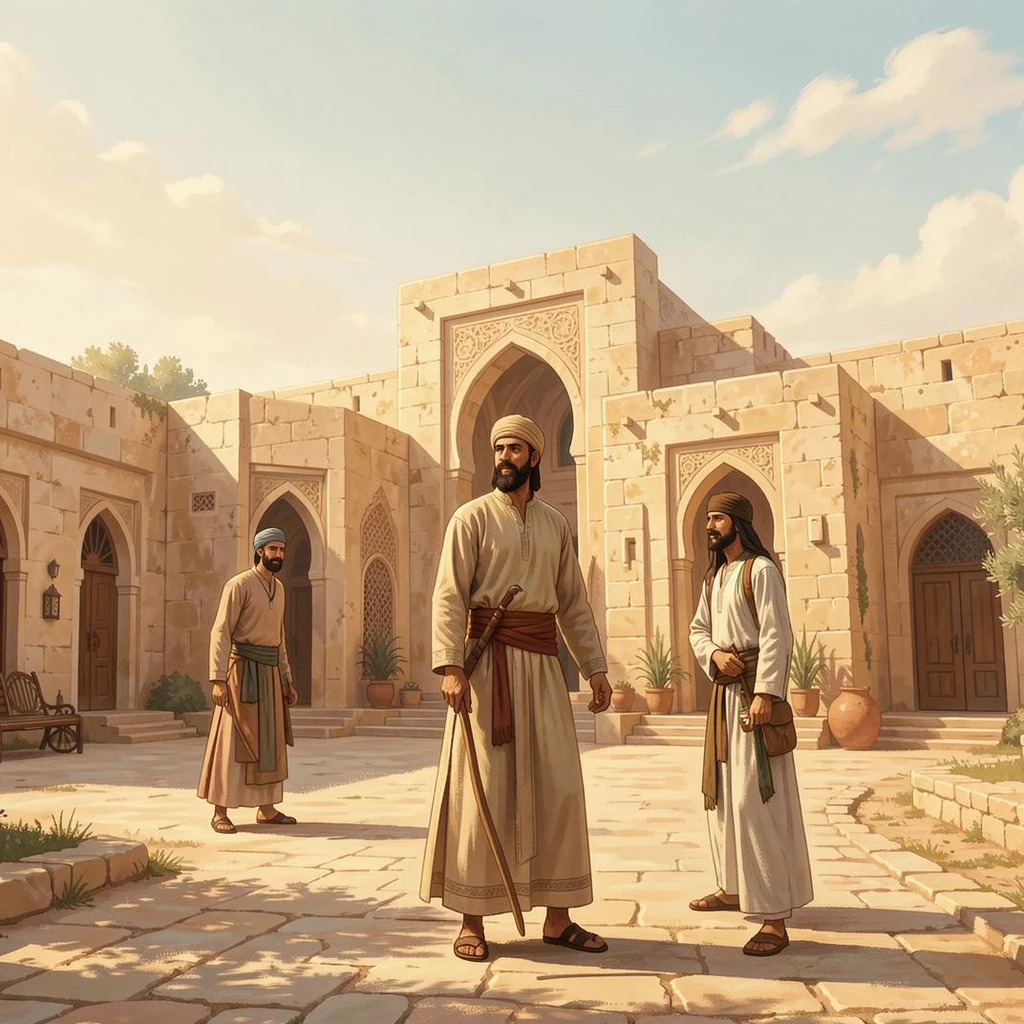
CHAPTER 3 — OCTOBER 2026: PESANTREN TEBUIRENG
Jombang, East Java. October 2026. 4:13 AM.
Tayeb woke to the sound of water running.
He was in the guest room—a simple cell, white walls, a mat on the floor, a pillow, a blanket. No bed. The window looked out onto the courtyard, now invisible in predawn darkness.
The water sound continued—a faucet, then another, then another. The splashing of water on stone. Then footsteps, sandals slapping, voices murmuring in Arabic and Javanese.
He checked his watch. 4:14 AM.
The first meal of the day, before the sun. The pesantren was waking.
He dressed quickly. Tunic, trousers, sandals. The clothes Kyai Abdullah had provided—cotton, loose, comfortable.
The door opened. A young man appeared—nineteen, twenty, student face, shaved head, wearing a white cap and a sarong.
“Bapak,” the student whispered. “Breakfast is ready.”
“Thank you.”
“Kyai Abdullah waits in the courtyard after breakfast. For dhikr.”
“Dhikr?”
“Remembrance. The morning practice.” The student smiled. “You will see.”
Tayeb followed him out into the corridor. Other students were emerging from their rooms—hundreds of them, moving quietly, sandals slapping on stone, voices low. The corridor filled with white figures, flowing like water toward the dining hall.
They walked outside into the courtyard. The predawn air was cool, humid, the sky a deep purple-black. Stars scattered overhead, bright and sharp.
The courtyard was larger than he’d expected from the map—perhaps a hundred meters across, paved in stone, with a covered walkway around the perimeter. A two-story building faced them—the mosque, with a mihrab niche pointing toward Mecca. Behind it, dormitories stretched into the darkness.
Students were everywhere now—flowing toward the dining hall, carrying plates and bowls, the clatter of ceramic and metal barely audible above the murmured conversations. Tayeb followed the crowd.
The meal was simple—nasi uduk, rice cooked with coconut milk and bay leaf, served with tempeh and fried tofu, a hard-boiled egg, and sweet tea. Students sat cross-legged on mats, eating quickly, efficiently. There was no talking in the dining hall—only the clatter of spoons, the sound of chewing, the occasional splash of tea being poured, the rustle of students preparing for the day’s classes.
Tayeb ate. The rice was warm, fragrant with coconut, the tempeh nutty and fermented. The tea was sweet with palm sugar.
They finished within minutes. The students rose, washed their bowls in the communal water trough—water splashing, hands moving in practiced rhythm—and flowed back toward the courtyard for morning classes. Some carried books—small Qurans, Arabic grammar texts, collections of hadith. Others carried writing slates and charcoal for memorization practice.
The sky was lightening now—purple turning to gray, the stars fading. The horizon was just beginning to glow with the first hint of dawn.
They gathered in the courtyard—thousands of them, sitting cross-legged in concentric circles around a central space. The courtyard surface was tiled in Javanese brick—bata merah—the reddish clay cool beneath the mats, each tile slightly uneven from decades of feet. The predawn air was cool, carrying the smell of dew on grass, of woodsmoke from cooking fires in the village beyond, of oud incense from the mosque, and underneath, the faint scent of kretek from the night watchman.
The sound died away. The courtyard became still. A rooster crowed from the village beyond the walls, then fell silent. In the distance, the adhan from the village mosque floated over—Allahu Akbar, Allahu Akbar—layering with the nearer sounds.
An old man appeared from the mosque building. Kyai Abdullah. Seventy-two years old, small, weathered, white beard trimmed close with faint red stains of sirih—betel nut. He wore a white sarung and white peci, and as he walked, his right hand automatically went to his mouth, returned to a small betel nut quid between cheek and gum. He moved slowly, deliberately, leaning on a wooden tongkat that had been worn smooth by decades of grip.
He reached the center of the courtyard. Sat cross-legged on a mat. Before closing his eyes, he leaned toward a young student nearby, whispered something about the boy’s posture—Luruskan punggung. Straighten your back. The student straightened. Kyai Abdullah closed his eyes.
The last murmur died. The courtyard was still.
Then he began to chant.
La ilaha illa Allah. There is no god but God.
The voice was deep, resonant, carrying across the courtyard without effort. Each syllable was distinct—the long i of ila, the deep ll of Allah, the vowel stretching until it seemed it would break, then resolving.
The students responded, their voices rising together: Allahu Akbar. God is greatest.
Not unison—there were thousands of voices, different pitches, different timbres. But they were synchronized, the response coming as a wave rather than a single sound. The baritones provided the foundation, the tenors the harmony, the occasional bass note grounding it all.
The rhythm began—one phrase every five seconds, slow enough that each syllable stretched to the edge of breaking. Call and echo, back and forth, the sound building and fading like breathing.
Astaghfirullah. I seek forgiveness from God.
The students responded: Astaghfirullah.
La hawla wa la quwwata illa billah. There is no power and no strength except in God.
The students responded: La hawla wa la quwwata illa billah.
The students’ bodies moved together. Not swaying, exactly, but a slow forward tilt at the waist on La, back on ila, forward again on illa, back on Allah. The movement was subtle, barely visible, but precise. Thousands of bodies moving as one. Bare feet pressed flat against cool tile. Heads remained bowed, chins nearly touching chests. Hands rested on knees, palms up, fingers slightly curled. Occasional twitch—a thumb pressing against a forefinger, a finger extending then curling back—the intensity of focus made visible.
Tayeb sat at the edge of the outer circle, watching. He didn’t know the words. He didn’t need to.
The sound was physical. It settled in his chest like a second heartbeat, in his bones like vibration. The chant continued: Muhammadan rasul Allah — Muhammad is God’s messenger. Astaghfirullah — I seek forgiveness from God. Each phrase stretched long, savored, the Arabic vowels carrying across the courtyard in the predawn dark. The dh sound, guttural and deep, seemed to come from somewhere beneath the courtyard itself. The r rolled, sustained, a thread connecting voice to voice to voice.
The chant continued for twenty minutes. Thirty. The sky lightened—gray turning to pink, the first birds beginning to call from the trees beyond the walls. From the dormitories, the sounds of preparation—students gathering books, reciting verses softly, the low murmur of study circles beginning.
Then the kyai shifted. The chant changed. Now they were reciting something longer—Al-Fatihah, the opening chapter of the Quran, Tayeb thought. The rhythm was different, more complex, the Arabic flowing like water, voices overlapping and separating, creating harmonies and dissonances that resolved and then separated again.
When the dhikr ended, students began to disperse—some to the mosque for semaan, the collective recitation of Quran, others to study circles for nahwu and sharaf, others to fiqh classes. Ustadz—younger teachers, themselves graduates of the pesantren—moved among the students, correcting pronunciation, guiding memorization.
The sun broke over the dormitories behind them. Light spilled across the courtyard, gold on white tunics, gold on reddish bata merah tile, gold on the kyai’s weathered face.
Silence settled. A cricket chirped once, then stopped.
The kyai opened his eyes. Looked around the circle. His gaze passed over hundreds of students, over the courtyard, over the pesantren buildings, over the rice fields beyond the walls.
His gaze settled on Tayeb.
“You are the guest from Tunisia,” the kyai said. His voice was soft, barely carrying across the courtyard.
Tayeb nodded. “Tayeb Damerji.”
“You are a solar engineer.”
“Yes.”
“And you are here to study our pesantren.”
“Yes.”
The kyai beckoned. “Come closer.”
Tayeb moved through the students, who shifted to make space. He reached the inner circle, sat cross-legged on the mat across from the old man.
Up close, the kyai was smaller than he’d seemed from a distance. His face was weathered, lined with decades of sun and study. His eyes were clear.
“You have questions,” the kyai said.
“Yes.”
“Ask.”
Tayeb hesitated. How to explain what he was looking for? How to explain Tunisia—the networks destroyed, the institutions dismantled, the TFR at 1.6, the empty cribs?
“The networks,” Tayeb said finally. “The pesantren. The NU. The waqf. They survived modernization. They survived independence. They survived dictatorship. They’re still here.”
The kyai waited.
“In Tunisia,” Tayeb continued, “they were destroyed. The zawiya closed in 1961. The waqf abolished in 1957. The marriage covenant restructured in 1956. Everything that held us together—gone.”
The kyai nodded slowly. His eyes were closed.
“And now?”
“Now the TFR is 1.6. Below replacement. The population is aging. The future is… uncertain.”
The kyai opened his eyes. “East Java is 1.98,” he said quietly. “Also below replacement.” He looked at Tayeb for a long moment, then looked away — at a student whose posture had slumped, at a strand of prayer beads that had fallen from a mat, at the morning sky.
“You have come far,” the kyai said finally. “From the other side of the sea. To find something.”
“Yes.”
“And what you seek — you hope it can be carried back. Across the water. To soil that is different. To people who are different.”
Tayeb was quiet.
The kyai was silent for a long moment. The students around them were motionless, listening.
“The BKKBN worker comes,” the kyai said finally, not answering Tayeb’s question directly. “She brings medicine. She brings knowledge. She says: two children is ideal. Prosperous. Modern. Like Malaysia, like Singapore.”
He adjusted his position on the mat, his joints cracking audibly. His fingers found the tasbih in his lap, the beads clicking softly. His other hand went to his mouth, returned—the betel nut staining his lips red.
“Yesterday, a father came to me. His daughter is married two years. No children yet. He asked: Should she see the doctor? Should she use the medicine? Is two children the path to prosperity?”
Tayeb waited.
“What did you tell him?”
“What could I tell him?” The kyai’s voice was soft, almost conversational. “I told him what my grandfather told me, and his grandfather before him. Allahu arzaq. God provides. Whether two children or four. Whether the harvest is good or bad. Whether the rain comes or does not come.”
He gestured vaguely toward the rice fields beyond the walls.
“The father nodded. He thanked me. He left. But I saw him later, walking with the BKKBN worker. She was showing him pamphlets. He was listening.”
Tayeb watched the old man’s face, weathered in the morning light.
“But the posters say two children,” Tayeb said. “The BKKBN worker says two children. And you… what do you say?”
“What do I say?” The kyai was quiet for a long moment. In the distance, a motorbike passed on the village road, the sound fading into the morning stillness.
“We say,” the kyai said finally, “that family planning is jaiz—permissible. For health. For education. For the welfare of the family. This is what the NU decided, long ago. Based on maslahah—public interest.”
“Is it sunnah?” Tayeb asked.
The kyai looked at him for a long moment. Then he smiled—a small, weathered smile.
“The government says two is ideal. The BKKBN worker says two is prosperous. Some of our ulama say two is sunnah—recommended.” He paused, his hand going to his mouth again. “But others say: who are we to count God’s blessings? Who are we to say what is ideal?”
“So what is the truth?”
“The truth?” The kyai shrugged—a small movement, barely visible beneath the white sarung. “The truth is different for each family. For some, two children is enough. For others, four. For others, none. The decision is between the family and God. The state cannot decide what only God knows.”
He looked at Tayeb, his gaze direct.
“The choice remains.”
“The choice,” Tayeb repeated.
“The choice.” The kyai leaned forward slightly. “But the guidance? That is between the family and their kyai. Between the family and God. Not the state.”
Tayeb was quiet. Morning light filled the courtyard. The sky above was pale blue, streaked with high clouds.
“But if the choice is always two,” Tayeb said, “then is it really a choice? If the pesantren says two is permissible, and the state says two is ideal, and the families choose two either way—then what’s the difference? What did you preserve that Tunisia destroyed?”
The kyai looked at him for a long moment. Then he called out to a passing student: “Yusuf—kaki kiri harus lurus.” Your left foot must be straight. The student adjusted his posture without breaking stride, the correction casual, unremarkable.
“You ask difficult questions,” the kyai said to Tayeb. Then, more softly: “The bamboo bends but does not break. This is what we preserved. The ability to bend, to accommodate, to survive.” He paused. “But you ask: does bending change what the bamboo is?”
He looked toward the mosque, then back at Tayeb.
“Stay. Observe. Ask. Learn.”
He paused.
“Then tell me: what transmits?”
The sun climbed. The rice fields beyond the walls rippled in the morning breeze, green waves stretching to the horizon. The betel nut quid in the kyai’s cheek shifted, his jaw working slowly, the red stain on his lips dark against his white beard. A student approached, bowed, whispered a question about the day’s schedule. The kyai answered without turning. The student bowed again and left. The courtyard was empty now, save for the two of them. The sun rose higher.