PROLOGUE — DECEMBER 2028: ISTANBUL DEPARTURE
Istanbul, December 2028. The announcement board flickered—TK 661, Gate B, now boarding. Tunis.
Tayeb stood at the window, the boarding pass in his hand. Below him, the Bosphorus strained between two continents, dark water and distant lights. Twenty-six months. Notebooks filled. Seeds in his pocket, wrapped in cotton.
He touched his breast pocket. Three notebooks, leather-bound, filled with questions. No answers.
The gate agent’s voice came over the PA, Turkish first, then English, then Arabic. The crowd shifted—businessmen in suits, women in hijabs, a family with a stroller, three men in taqiyehs performing wudu in the airport prayer room’s sink. Transit. Everyone moving through.
He had left Jakarta sixteen hours ago. Tropical heat, monsoon season, the call to prayer layering over the capital like thunder. Now Istanbul, winter, the air conditioning cold against his skin. His body didn’t know what season it was anymore.
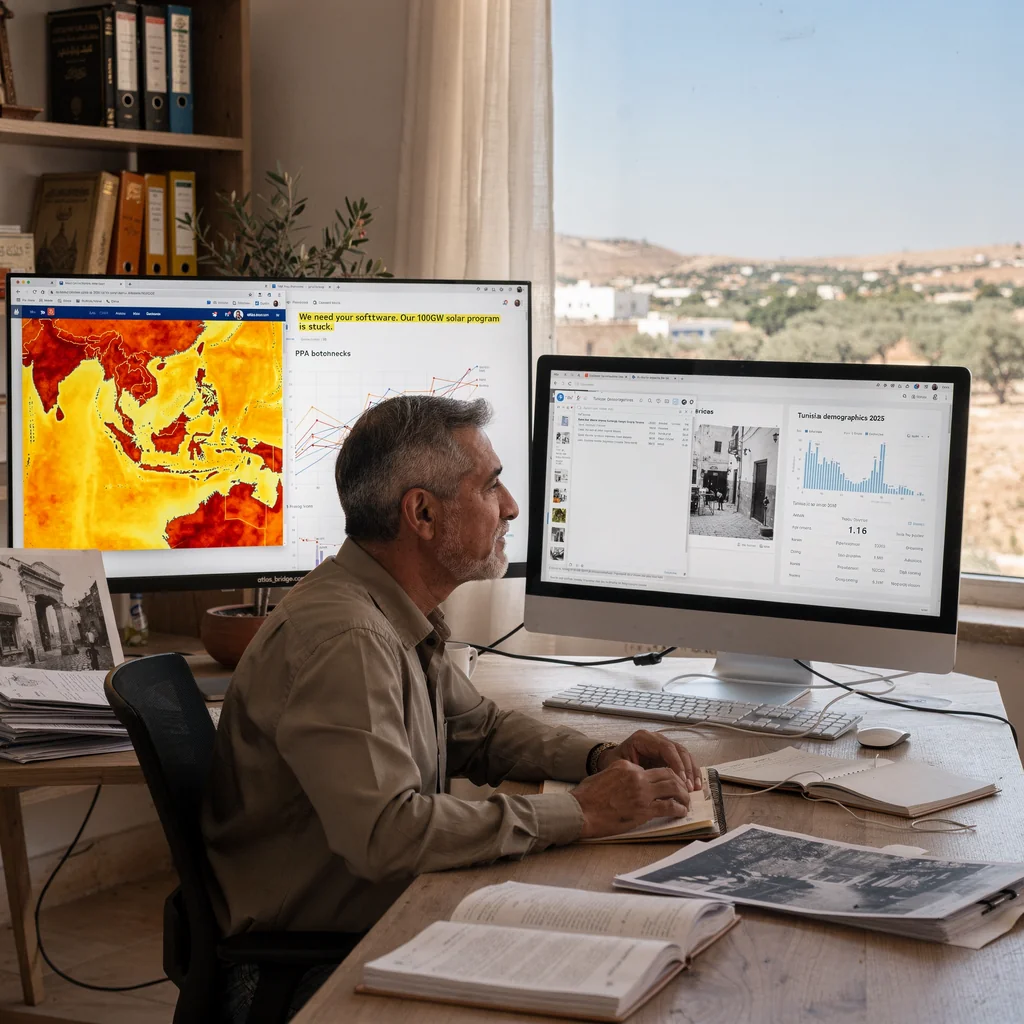
He checked his watch. December 14, 2028. Sixty-two years old. The math ran without permission: eight months planning the trip, three years before that watching television reports and downloading Indonesian PDFs at two in the morning in the olive grove office.
He patted his left pocket. The seeds. Wrapped in cotton, then in a handkerchief, then in a ziplock bag. Rice seeds—Oryza sativa, Javanica varieties from East Java, two varieties that the pesantren kyai said had grown in those fields since before the Dutch. The kyai had given them to him the morning he left. Not a ceremony. Just a small cloth pouch, pressed into his hand.
“If they grow in Tunis soil,” the kyai had said, “then something transmits.”
Tayeb had nodded. He hadn’t said: And if they don’t? What does that mean?
Now the seeds were in his pocket. The notebooks were in his breast pocket. The boarding pass was in his hand. The question that had sent him to Indonesia and was bringing him home now was this:
What survives when networks assimilate the state’s demographic logic?
He knew what Indonesia had done. Not the outcome—that was invisible from where he stood. But the mechanism: he could see it still. The clinic in Jombang, posters fresh on the wall—two children, smiling, the paint not yet faded. The midwife in Surabaya who showed him the inquiry log, numbers climbing, then shrugged. Interest up. Uptake flat. The kyai in the rice-field pesantren who’d looked at him calmly and said two children was jaiz, permissible, even sunnah—recommended. The pesantren still teaching. The zakāt still flowing. The community still governing itself. The state’s logic had entered through the doors, but the walls still stood.
The outcome: unknown.
He opened the first notebook. The cover was worn, the spine cracked. He’d written in it every day for twenty-six months. The first entry, September 12, 2026: Arrived Jakarta. Heat like a wall. Posters everywhere. Happy families with two children. The paint is still wet.
The last entry, written this morning in the transit hotel: I carry home the mechanism. Not the result. Is there something else—something that transmits despite it?
He closed the notebook.
The announcement board changed: FINAL CALL, TK 661, GATE B.
He picked up his carry-on. One bag in, one bag out. Two years, and it still fit.
He walked toward the gate. The crowd thickened. A woman in a beige trench coat argued on her phone in French. A teenager with headphones slouched against a pillar, scrolling through a feed. The smell of cardamom coffee drifted from somewhere behind him. A child in a stroller cried, the mother shushing softly. The call to prayer echoed from the airport mosque—a man’s voice, amplified, thin against the announcement board’s electronic drone.
Tayeb had heard the call to prayer in Indonesia a thousand times. Layered over Jakarta, five mosques within earshot, the calls beginning seconds apart, creating a canyon of sound. He’d heard it in the pesantren at 4:15 AM, the kyai’s voice leading the dhikr, the students responding, the chant spreading through the courtyard and out into the rice fields. He’d heard it in the village mosques of East Java, the loudspeaker cracked, the muezzin’s voice rough with age.
Everywhere, the adhan. And everywhere, the same quiet accommodation—the networks preserved, still teaching, still governing their own, but two children now jaiz and sunnah. The state had asked its question. The networks had answered in their own language. The fertility still falling.
He reached the gate. The agent scanned his boarding pass. Beep. Go through.
He walked down the jet bridge, the corridor narrowing, the plane visible through the glass at the end. Turkish Airlines, red tail, white fuselage. The connection: Jakarta to Istanbul to Tunis. The long way home.
He found his seat—12A, window. Stowed his carry-on. Buckled in.
The plane filled. A businessman sat next to him, opened a laptop, began typing in German. A woman across the aisle took out a rosary, began counting in Italian. Behind him, two men spoke in Arabic about the price of dates in Medina.
Tayeb looked out the window. The tarmac, the lights, the Bosphorus dark beyond. The engines started—a whine, then a roar, then the forward motion, the plane turning, backing away from the gate.
He’d flown the other direction two years ago. Tunis to Istanbul to Jakarta. He’d carried a different question then: What did Indonesia do right? What preserved their networks when ours were destroyed? How did they maintain autonomy when Bourguiba dismantled our institutions?
He’d assumed he’d find a blueprint. A model. Something he could bring home, apply to Tunisian soil, make the cribs fill again.
He hadn’t found a blueprint.
He’d found questions.
The notebook in his breast pocket, the one he’d filled this morning, held two entries:
Pesantren, October. Dhikr at dawn. Two children blessed as sunnah. Networks alive. Fertility below replacement.
Eastern village, June. No roads yet. Women with eight, ten children. No clinics. No posters. Not transmission—just poverty. When the roads come, this falls too.
He touched the notebook through his shirt. He didn’t have an answer.
The plane accelerated. The pressure pushed him back into his seat. The Istanbul runway rushed past—lights, stripes, the dark beyond—and then the lift, the nose up, the ground falling away.
Below him, the Bosphorus narrowed, the continents separated, Europe and Asia pulling apart like torn paper. The city lights faded. Clouds covered everything.
He opened his notebook again, turned to the final page. The last thing he’d written:
Seeds. Notebooks. Mechanism without result. The cribs await in Tunis. The trees endure.
He closed the notebook. He closed his eyes. The engines hummed.