CHAPTER 14 — FEBRUARY 2035: RECOVERY
One
February 2035. The storms had passed, but the damage remained.
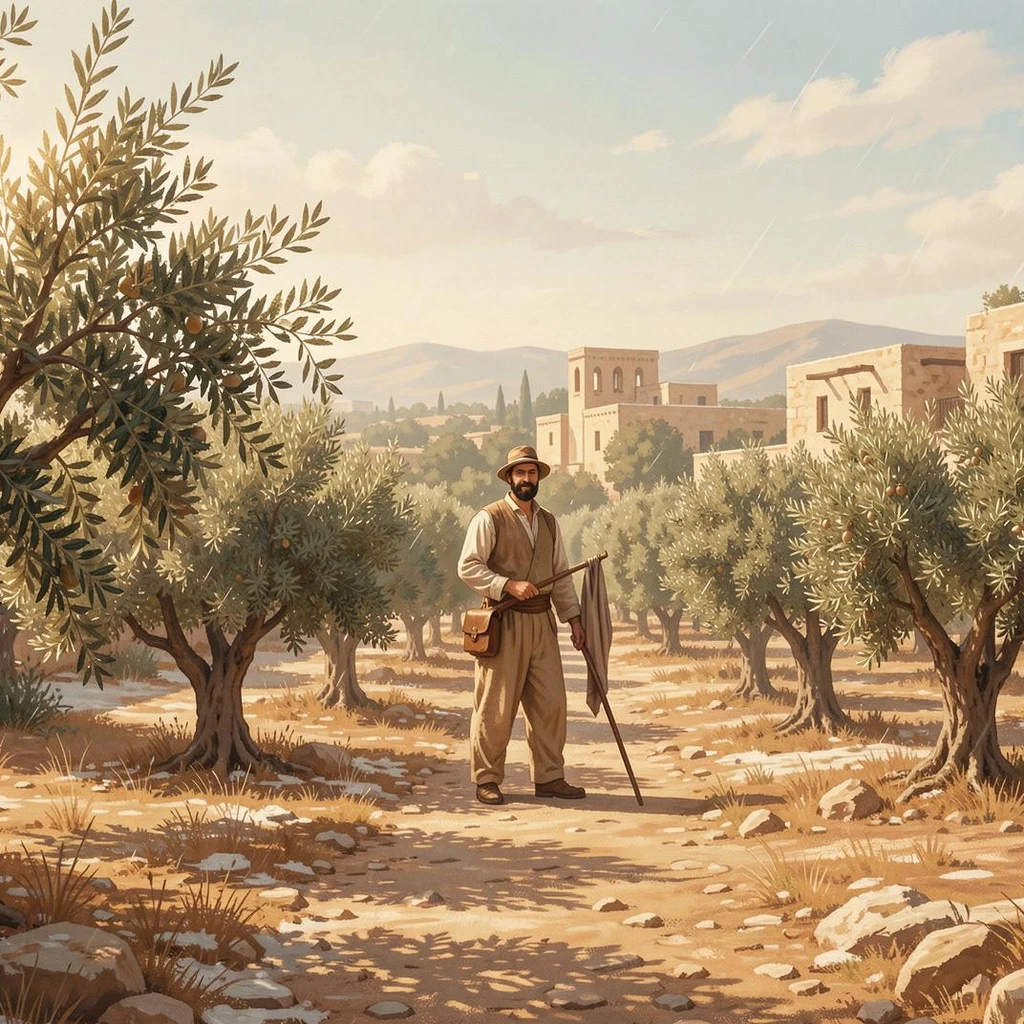
Tayeb walked the grove at dawn, his boots sinking into the mud that had been frozen solid three weeks before. The winter had been harsh—cold winds from the interior, rain that had sheeted across the Cap Bon peninsula for days, a brief snowfall that had coated the limestone hills in white before melting into the soil.
Now the damage was visible.
He stopped at Row Seven, Tree Twelve. A main branch had splintered under the weight of snow and wind—the wood pale where it had broken, the jagged edge pointing upward like a question mark. The branch lay in the mud beneath the tree, its leaves already brown and curling.
He counted: one, two, three, four. Five broken branches in Row Seven.
He moved to Row Eight. Three broken branches. Row Nine: four.
He walked the entire grove—seventy-three trees, planted by his grandfather, planted by his grandfather’s grandfather, planted by generations of Damerjis who had worked this soil since 1883. Seventy-three trees. Twenty-seven broken branches.
The trees stood. The branches had fallen.
Tayeb stood in the mud at the edge of the grove, his breath visible in the cold air. He had not slept through the night for weeks—since November, since the crisis, since the collapse of what he had tried to build.
What had collapsed?
Everything.
The recovery project had grown too fast. Five zawiyas became twelve, twelve became twenty-five, twenty-five became—the planning documents had said forty, but the reality had been less organized, more chaotic, a spreading of something that had not yet found its shape. The state had noticed. The Ministry of Religious Affairs had sent an envoy. The Ministry of Interior had sent another. The offer had been made: partnership, funding, recognition, integration into the national framework for religious associations.
The circle had deliberated. They had debated. They had divided—some wanted partnership, some wanted independence, some saw no alternative to state funding, some saw in the state’s offer the same mechanism that had destroyed the networks in the first place.
The deliberations had lasted through October, through November. Then the collapse.
Not a violent collapse. Not a dramatic schism. Something quieter—people stopped coming. Funding dried up. Volunteers disappeared. The energy that had fueled the recovery for five years simply… evaporated. By December, only three zawiyas were still operating. By January, only the grove itself remained.
Youssef had taken the Ministry’s terms. He ran a state-recognized zawiya in the Medina now — he had reasons Tayeb understood, even if he disagreed. The Medina zawiya was the building his grandmother had attended as a child, before 1961. The state had allowed him to use it for religious activities again, in exchange for accepting the Ministry curriculum. He was teaching what he could within the constraints.
Amira had returned to her research. Her doctoral thesis on the recovery project’s collapse would matter, differently — the data she had gathered, the documentation of what the circle had achieved, the analysis of why the bond had failed to scale, would reach other researchers, other seekers, other people trying to understand what survived when networks were destroyed.
Malik had gone to Germany. The grove’s failure had been the last straw. His cousin in Stuttgart had found him work — construction, solar installation. He had left with a duffel bag and a sense of incompleteness, needing to depart before watching the slow death of what he had helped build.
These were losses, not betrayals. Tayeb did not blame them. Each had made a different calculation, reached a different conclusion about what was possible in the aftermath of collapse. Each had found a different way to carry forward something of what they had learned.
Tayeb had walked the grove then, in January, counting what remained. Three active zawiyas. Forty-two students who had not left. Most of them he barely knew — faces that had joined during the chaotic expansion, names he had learned but not stories, strangers drawn by the cargo without understanding the vehicle. The solar panels still generating electricity, still powering the community center, still feeding into the grid—a silent testament to what had been achieved, a silent question about what would become of it.
He had not visited his father’s grave since November.
Hafedh had died in 1998. Tayeb had replanted the grove—the trees that now stood, the trees that had survived the storms. His father had been the bridge generation: the son who had received the transmission intact, who had watched the dismantling, who had tried to recover what had been lost and had failed, who had died before Tayeb had begun his own recovery work.
What would his father say about the collapse?
Tayeb didn’t know. He hadn’t visited the grave since the crisis began. He hadn’t wanted to hear the silence from the stone, the absence of answer from the man who had asked the same questions, who had tried the same recovery, who had failed.
Now he walked through the mud, counting broken branches.
Twenty-seven branches broken. Forty-six trees undamaged. The grove stood.
The pattern repeated itself in his mind—not for the first time, not for the hundredth time. What could be rebuilt? What could not? What was the difference between restoration and recovery? What survived the storm?
He reached the end of Row Thirteen, the southern edge of the grove. Beyond the trees, the Mediterranean was visible through the haze—gray-blue, winter-cold, the shore invisible at this distance. The wind came off the water, cutting through his coat, cold against his skin.
He should be at the office. Atlas_bridge had clients. The solar consulting business was growing—Tunisia, Morocco, Algeria, even a contract in Libya. The software worked. The clients paid. The business succeeded.
But the recovery project had collapsed.
He should rebuild. He should restart. He should—
The thought stopped there. He didn’t know what should come next.
Two
What he didn’t know: The practice had continued without him.
November 16, 2034. Three days after the circle’s final meeting. Three days after Youssef’s announcement. Three days after the recovery project collapsed.
Yassin, Omar, and Sami met in the grove at dusk.
No one told them to come. No one organized the gathering. They arrived separately — Yassin from the university library, Omar from his family’s home in the Medina, Sami from the internet cafe where he’d been reading about agricultural techniques.
They found each other at the edge of Row Seven, where Tayeb had cut the broken branches three weeks before. The stumps were visible on the trees, raw wood exposed to the air.
“They’re gone,” Omar said. “Youssef, Amira, Malik. Everyone.”
“Not everyone,” Yassin said.
The three of them. That was not everyone.
“What do we do?” Sami asked. “Do we stop?”
No one answered.
Yassin sat on the ground beneath the olive tree — the same tree, Row Seven Tree Twelve, where Tayeb had led dhikr practice for two years. The same tree where Youssef’s grandmother had recited the old formulas before she died. The same tree whose broken branch now lay in the courtyard pile, waiting for disposal.
Omar sat beside him. Sami sat beside Omar.
They sat in silence. The wind moved through the branches. The Mediterranean was visible beyond the grove, gray-blue in the November light.
“What did we learn?” Yassin asked. “In the two years we practiced. What did we receive?”
“The dhikr,” Omar said. “The formulas. The rhythms.”
“The deliberation,” Sami said. “The collective discernment. The way we talked until we reached agreement.”
“The listening,” Yassin said. “The way we learned to hear each other. The way we learned to hear — something else.”
“God?” Omar asked.
“Maybe,” Yassin said. “Maybe not. Something beyond ourselves. Something that emerged when we practiced together.”
The branches stirred again.
“Can we practice without Tayeb?” Sami asked. “Can we practice without Youssef? Can we maintain — whatever this is — with just the three of us?”
No one knew.
Yassin began the dhikr. La ilaha illa Allah. No rhythm, no melody, just the words, spoken quietly.
Omar joined. La ilaha illa Allah.
Sami joined. La ilaha illa Allah.
They sat beneath the olive tree, three young men in their twenties, repeating the formula, their bodies swaying slightly, the words finding a rhythm they hadn’t practiced in months.
La ilaha illa Allah. La ilaha illa Allah. La ilaha illa Allah.
A breeze passed through the branches. The leaves shimmered silver-green. The Mediterranean beyond the grove caught the last light, gray-blue turning to gold.
They practiced for twenty minutes. Then thirty. Then an hour.
When they stopped, the silence was different — not empty, but full.
“We can practice,” Yassin said. “The three of us. We can maintain the practice.”
“But what’s the point?” Omar asked. “If we’re not building anything. If we’re not recovering the networks. If it’s just the three of us, sitting in a grove, reciting words — what are we doing?”
Yassin didn’t answer immediately. He looked at the trees. He looked at the stumps where branches had been cut. He looked at the soil beneath his feet.
“Maybe the point isn’t to build,” he said. “Maybe the point is to be ready.”
“Ready for what?”
“For the right conditions,” Yassin said. “For the cambium to be active. For the sap to rise. For the possibility of — something.”
“What something?”
“I don’t know,” Yassin said. “But if we stop practicing, if we lose the capacity, then when the conditions are right, we won’t be ready to receive what’s possible.”
Sami understood. “Like the farmers say. You prepare the soil. You wait for rain. You don’t make the plants grow. You create the conditions where growth is possible.”
“Yes,” Yassin said.
“So we practice,” Omar said. “The three of us. Until — what? Until others come? Until Tayeb returns? Until something changes?”
“Until we’re ready,” Yassin said. “For whatever comes next.”
November 23, 2034. They met again.
This time they brought notebooks — the notes they’d taken during circle meetings, the observations they’d written, the reflections they’d documented. They compared what they’d learned.
“The dhikr practice,” Sami said, reading from his notebook. “The purpose isn’t the words. The purpose is the state. The heart contraction. The way the chest tightens when the truth lands.”
“I’ve never felt that,” Omar said.
“Me neither,” Yassin said. “But I’ve seen it. In Tayeb. Sometimes in Youssef. When the deliberation reaches consensus, and everyone in the circle feels it — that’s the state we’re seeking.”
“So we practice the dhikr,” Omar said, “even if we don’t feel the state. Even if it’s just words. Because the practice creates the conditions for the state to emerge.”
“Yes,” Sami said.
They opened the Indonesia notebooks — the ones Tayeb had brought back, the ones he’d shared with the circle, the ones they’d borrowed and studied. The pages were filled with Tayeb’s careful handwriting: observations from Pesantren Tebuireng, notes from NU headquarters, transcripts of conversations with kyai and waqf managers and farmers.
“He learned from them,” Yassin said. “But he couldn’t transplant what he learned.”
“Because the soil was different,” Omar said. “Because the history was different. Because what survived in Indonesia couldn’t survive in Tunisia.”
“But something can grow,” Sami said. “Not what was lost. But something that carries the memory.”
He pointed to a passage in the notebook — Tayeb’s description of grafting, the technique he’d learned from Javanese farmers. The scion carries the genetic memory of the old tree. The rootstock provides the foundation for new growth. The result is not the old tree, but something new — something that carries what survived while growing in its own way.
“Grafting,” Yassin said. “That’s the metaphor.”
“What do we graft?” Omar asked.
“The old techniques,” Yassin said. “The dhikr practice. The deliberation. The collective discernment. Those are the scions — the sound wood from the broken branches.”
“What’s the rootstock?”
“The new conditions,” Sami said. “The reality of Tunisia in 2034. The destroyed networks. The absence of institutions. The three of us, sitting in a grove, trying to recover something we never knew.”
They practiced dhikr. They discussed the notes. They deliberated — not big decisions, but small ones. Should they invite others? Should they tell Tayeb? Should they continue meeting in secret?
No consensus emerged. But the deliberation continued — the process itself becoming the practice.
December 2034. The winter rains came.
The grove turned to mud. The temperature dropped. The three young men continued meeting — now in the community center, now in Yassin’s apartment, now in the courtyard when the rain stopped.
They began visiting farmers.
The first visit was to an old man in the neighboring village — Ahmed, seventy-eight years old, his hands weathered from decades of working the soil. His grandfather had worked alongside Tayeb’s grandfather in the 1920s, before the dismantling, before the networks were destroyed.
“We’re learning about grafting,” Yassin said. “About agricultural techniques from the old period.”
Ahmed looked at them — three university boys, clean hands, clean clothes, city kids playing at farming. “What do you want to know?”
“Everything,” Sami said. “What techniques did your grandfather use? How did he propagate trees? How did he prepare the soil?”
Ahmed was quiet. Then he stood up. “Come with me.”
He led them to his orchard — twenty olive trees, some old, some young, all standing in rows that followed the contour of the land. He stopped at a tree with an unusual scar near the base — a diagonal line where the bark had healed around a join.
“This tree,” Ahmed said. “My grandfather grafted it. In 1947. The scion from a tree that produced excellent oil. The rootstock from a wild tree that grew in difficult soil.”
He touched the scar. “The graft took. The tree grew. It produced olives for sixty years.”
He looked at the three young men. “You want to learn? Then learn this: The tree knows what it needs. Your job is to listen. To watch. To pay attention to the soil, to the wind, to the water. The grafting is just a technique. The real knowledge is the listening.”
He spent the afternoon with them — walking through the orchard, explaining how to read the bark, how to test the soil, how to recognize when a tree was ready for grafting. He showed them which branches to select for scions — young wood, vigorous growth, sound tissue. He showed them how to prepare rootstock — healthy roots, vigorous growth, the right diameter for the scion.
“This is the old knowledge,” Ahmed said. “Before the state programs, before the modern techniques, before everyone forgot that trees know what they need if you listen.”
He looked at them. “Why do you want to learn this? You’re university boys. You’ll work in offices. You’ll leave the soil behind.”
“We’re not leaving,” Yassin said. “We’re staying. We’re learning.”
“Why?”
“Because something was destroyed,” Yassin said. “And we’re trying to recover what survived.”
Ahmed was quiet. He looked at the three young men, really looked at them for the first time — not as city boys playing at farming, but as something else.
“The networks,” he said. “The zawiyas. The old ways.”
“Yes,” Omar said.
“They were destroyed before you were born,” Ahmed said. “What can you recover?”
“Not what was lost,” Sami said. “What survived.”
“The living tissue,” Yassin said. “The sound wood that survived.”
Ahmed nodded slowly. He understood the metaphor. “Then come back next week. I’ll teach you how to prepare the scions.”
January 2035. The three young men continued meeting.
They practiced dhikr in the community center, the sound of their chanting carrying into the winter night. They studied the old agricultural manuals Sami had found in the university archives — documents from the 1920s, written in French, describing techniques that had been passed down for generations. They visited Ahmed and other farmers, learning the listening, the observation, the patience.
They began preparing rootstock.
Sami had obtained cuttings from wild olive trees — hardy stock that grew in difficult conditions, plants that had survived without irrigation, without fertilizer, without care. He planted them in small pots, using soil from the grove, mixing in compost he’d made from olive pulp.
“They’ll need time,” Sami said. “Six months before they’re ready for grafting. Maybe longer.”
“We have time,” Yassin said.
“What are we waiting for?” Omar asked. “For the rootstock to be ready? For the right season? For what?”
“For the possibility,” Yassin said. “For something to grow.”
January 2035. Tayeb walked the grove alone, counting broken branches, thinking the recovery project had collapsed.
He didn’t know the practice had continued without him.
He didn’t know three young men were meeting in the community center, reciting dhikr, studying agricultural manuals, visiting farmers, preparing rootstock.
He didn’t know something was already growing.
He didn’t know — until the sound of wood splitting came from the courtyard.
Three
The sound of wood splitting came from the courtyard.
Tayeb turned from the grove, walking back toward the farmhouse. The sound came again—sharp, clean, the crack of an axe against wood.
He entered the courtyard. The sound stopped.
Three young men stood in the open space between the farmhouse and the community center. One held an axe. One held a saw. One held a measuring tape.
They were in their twenties—students from the recovery project, the forty-two who had not left when the collapse came. Tayeb knew their names: Yassin, Omar, Sami. He knew their stories: university students, children of the professional class, grandchildren of the generation that had destroyed the networks, seeking something they had never known.
They stood now among the fallen branches—branches Tayeb had dragged from the grove over the past weeks, branches piled against the courtyard wall, waiting for disposal.
Yassin held the axe. Omar held the saw. Sami held the measuring tape, stretched across a particularly long branch from Row Seven, Tree Twelve.
“What are you doing?” Tayeb asked.
The three young men turned. They had not heard him approach.
“Uncle,” Yassin said. “We didn’t expect you.”
“What are you doing?”
Sami gestured to the branch beneath the measuring tape. “This one is sound. The break is clean. We can graft it.”
“Graft it?”
“Onto the rootstock.” Sami pointed to the courtyard wall, where a row of saplings stood in pots—small olive trees, their trunks thin, their leaves sparse, their roots wrapped in burlap. “We prepared the rootstock last month. From cuttings. We’ve been waiting for scions.”
“Scions?”
“The branches you cut from the grove.” Omar picked up a smaller branch, its leaves still green despite weeks in the courtyard pile. “If the wood is sound, we can graft. If the graft takes, the branch becomes part of the new tree.”
Tayeb looked at the saplings along the wall. There were a dozen—small, vulnerable, their root systems barely established. “You prepared these?”
“We read about it,” Sami said. “In the old agricultural manuals. From the 1920s. The techniques your grandfather used. We wanted to understand.”
“Why?”
The three young men looked at each other. Something passed between them—a question, a decision, an agreement.
“Because the recovery project collapsed,” Yassin said. “Because we don’t want it to be over.”
“The state’s offer,” Omar said. “The funding, the partnership, the recognition. Some of us wanted it. Some of us didn’t. The deliberations went on for weeks. And then…”
“Then nothing,” Sami finished. “People stopped coming. The energy just… evaporated.”
Tayeb waited. He had watched this happen. He had lived it.
“We didn’t stop,” Yassin said. “The three of us. We kept meeting. In the grove, in the community center. We read the notebooks you brought from Indonesia. We studied the old agricultural manuals. We asked questions.”
“What questions?”
“About the networks,” Omar said. “About what was destroyed. About what can be rebuilt.”
“We realized something,” Sami said. “The old way is gone. The zawiyas, the waqf, the transmission chains—your father’s generation tried to restore them. Your grandfather tried to preserve them. They couldn’t.”
“They were destroyed,” Tayeb said. “The institutions were abolished. The property was confiscated. The teachers were silenced. The transmission was broken.”
“Exactly,” Yassin said. “So restoring what was lost is impossible. The foundation is gone.”
The wind moved through the courtyard. The fallen branches shifted against the wall.
Yassin pointed to the saplings against the wall. “Grafting. The scion comes from your grandfather’s grove—living wood from what survived. The rootstock is new, grown from cuttings, adapted to current conditions.”
He picked up one of the branches from the pile, turned it in his hands. “The old tree. New roots. Something that wasn’t here before.”
Tayeb looked at the saplings. Thin trunks, sparse leaves, roots barely established in the burlap. Vulnerable. Alive.
“Where did you learn this?” he asked.
“The old manuals,” Sami said. “And we asked.”
“Asked who?”
“The farmers in the region.” Yassin set down the axe. “The ones who still work the soil. The ones whose grandparents worked with your grandfather. We visited them. We showed them the manuals. They taught us.”
“What did they teach you?”
“To listen to the trees,” Omar said. “To watch the soil. To pay attention to the wind.”
“To notice when a branch is sound,” Sami added, “and when it’s ready for grafting.”
Yassin picked up the measuring tape, stretching it again across the branch from Row Seven, Tree Twelve. “This one is ready. The wood is sound. The break is clean. The cambium is alive. We can graft it today.”
He looked at Tayeb. “Will you watch?”
Four
The grafting took three hours.
Yassin and Omar worked with the knife and the wax—the cutting, the joining, the sealing. Sami managed the rootstock, selecting which sapling would receive which scion, matching the branch diameter to the rootstock diameter, ensuring compatibility.
Tayeb watched. He said nothing. He asked no questions. He simply watched as the three young men worked with care, with precision, with a patience that he had not seen in the months of deliberation, the weeks of collapse.
The wind moved through the courtyard. The clouds broke, sunlight falling on the work.
When the last graft was sealed, when the last pot was watered, when the last sapling was returned to its place against the wall, the three young men washed their hands at the courtyard pump.
“How many?” Tayeb asked.
“Twelve grafts,” Yassin said. “We’ll know in six weeks which ones take. The success rate should be… we hope for fifty percent.”
“Six new trees.”
“If they take.” Omar dried his hands on his trousers. “If they don’t, we try again.”
“The season is right,” Sami said. “The sap is rising. The cambium is active. The conditions are favorable.”
They stood in the courtyard together—the old man and the three young. The fallen branches were still piled against the wall, but now some had been transformed. The sound wood, the living tissue, had been joined to new rootstock. The dead wood would be burned.
“What happens next?” Tayeb asked.
The three young men looked at each other.
“We continue,” Yassin said. “The grafting. The learning. The practice.”
“We’ll show you everything we’ve learned,” Omar said. “From the farmers. From the manuals. From the grove.”
“If you want,” Sami said.
Tayeb looked at the saplings against the wall. Twelve pots, twelve grafts, twelve possibilities.
“How many of you?” he asked. “Still meeting. Still practicing.”
“Three,” Yassin said. “The ones who didn’t leave when the collapse came.”
“And the others?”
“They might come back,” Omar said. “If they see something growing. If they see that recovery is possible.”
“They might not,” Sami said. “And that’s all right. Three is enough to begin. Three is enough to practice. Three is enough to learn.”
The wind moved through the courtyard. The smell of rain approached—another winter storm coming from the sea.
“Teach me,” Tayeb said.
The three young men turned.
“Teach me what you’ve learned,” he said. “The grafting. The listening. The practice. What you’ve learned from the farmers. What you’ve discovered in the old manuals. Teach me.”
Yassin smiled—a small, genuine expression. “We thought you’d never ask.”
Five
The afternoon passed in practice.
Yassin taught him how to hold the grafting knife, how to angle the cut, how to match the cambium layers. Omar taught him how to test the wood for soundness, how to recognize when a branch was alive beneath the bark. Sami taught him how to select rootstock, how to prepare the soil, how to water without drowning the fragile new roots.
They practiced on the remaining fallen branches—the dead wood, the broken pieces that would not take, the material for learning rather than creating.
“Your grandfather,” Sami said, as Tayeb practiced a diagonal cut. “The farmers remember him. They remember his father. They remember the techniques.”
“They taught you these techniques?”
“They taught us the principles,” Yassin said. “The listening. The observation. The patience. The rest we learned from the manuals and from practice.”
Tayeb set down the knife. The branch in his hand was cut cleanly, the angle precise, the cambium exposed. “Why did you stay? When the others left?”
“Because we had nothing to lose,” Omar said.
Tayeb waited.
“Our parents’ generation,” Sami said, “they destroyed the networks. They don’t know what was lost. They don’t know what we’re seeking.”
“Our generation,” Yassin said, “we grew up with nothing. No zawiyas. No transmission. No networks. Just the state, the market, the individual.”
“We sought something else,” Omar said. “We found your recovery project. We found the possibility of something different.”
“And when it collapsed,” Sami said, “we realized—we didn’t need the project to continue seeking. We could continue ourselves. Three of us. In the grove. Learning. Practicing. Waiting.”
“Waiting for what?”
“For the right conditions,” Yassin said. “For the cambium to be active. For the sap to rise. For the possibility of grafting.”
“Or,” Omar said, “for someone to ask us to teach them.”
Tayeb looked at the three young men. They stood in the courtyard, their hands stained with grafting wax, their clothes spattered with mud. They had been practicing for three months—since the collapse, since the others left, since the recovery project had evaporated.
They had not waited for permission. They had not waited for funding. They had not waited for state recognition.
They had practiced.
“I tried to rebuild what was destroyed,” Tayeb said. “For five years. The institutions. The networks. The transmission.”
“And?” Yassin said.
“It collapsed. Everything I built—gone.”
Yassin pointed to the saplings against the wall. “Not everything.”
Tayeb looked at the saplings—thin trunks, sparse leaves, roots barely established. Not the old trees. Not the grove his grandfather had planted. Something new.
The first raindrops fell—cold, sharp against the courtyard stones. The three young men moved the saplings against the wall, under the shelter of the overhang. Tayeb helped them carry the last pots, his hands careful around the burlap-wrapped roots.
“The grafts need protection from the storm,” Yassin said.
“They need time,” Omar said. “Six weeks before we know if they’ve taken.”
“They need care,” Sami said. “Water. Sunlight. Attention.”
Tayeb set the last pot in place. The sapling inside was small—six inches tall, thin trunk, four leaves. The scion was bound to the rootstock with grafting tape, sealed with wax. The union was covered with soil.
“This one,” Tayeb said. “The scion. Which tree did it come from?”
“Row Seven, Tree Twelve,” Sami said. “The branch that broke in the storm.”
Tayeb touched the soil around the sapling. “My grandfather planted that tree. In 1923.”
The three young men waited.
“My father was the bridge generation,” Tayeb said. “He received the transmission intact. He watched the dismantling. He tried to recover what was lost. He couldn’t.”
“He replanted the grove,” Yassin said.
“He tried to restore the networks,” Omar said.
“He failed,” Sami said.
“He died before I began,” Tayeb said. “Before I even understood what had been lost. Before I knew what I was seeking.”
The rain fell harder now, drumming against the courtyard stones, flowing through the cracks in the ancient flagging.
“Where is he buried?” Yassin asked.
“The family plot,” Tayeb said. “Beyond the southern edge of the grove. Under the carob tree.”
“Can we visit?” Omar asked.
Tayeb looked at the three young men. They stood in the rain, their hands stained with grafting wax, their clothes spattered with mud. They had not left when the recovery project collapsed. They had not abandoned the practice.
He nodded. “This way.”
Six
They walked to the family plot through the rain—four figures moving across the winter-brown grass, toward the carob tree at the southern edge of the grove.
The stones were visible beneath the tree—four graves, four stones, four generations. His father. His grandfather. His great-grandfather. The ones who had worked this soil, who had received the transmission, who had watched the dismantling, who had tried and failed to recover what was lost.
Tayeb stopped at his father’s grave. Hafedh al-Damerji, 1928-1998. The bridge generation. The son who had received intact networks and watched them destroyed. The father who had tried to rebuild and failed. The man whose silence Tayeb had feared for three months.
The three young men stood behind him, silent, respectful.
The rain fell on the stone, pooling in the carved letters of his father’s name. Tayeb touched the marble—cool and wet beneath his fingers. He had not come since November. He had not wanted to stand here, in the silence, facing the fact that he had tried what his father tried and failed the same way.
But now his hands smelled of grafting wax. His clothes were spattered with mud from the courtyard. His fingers remembered the angle of the cut, the pressure of the join, the patience of the seal.
He placed his palm flat against the stone. The rain ran over his knuckles, down the marble, into the soil at the base of the carob tree.
The three young men stood behind him in the rain, waiting.
He turned from the grave and walked back toward the grove.
Seven
They walked back to the farmhouse as the rain slowed. The sun broke through the clouds—late afternoon light, golden on the wet grass, on the olive trees, on the saplings sheltered against the courtyard wall.
“We should check the grafts,” Yassin said. “Make sure they weren’t damaged by the rain.”
“We should water them,” Omar said. “The moisture in the soil, the protection from the storm.”
“We should prepare for tomorrow,” Sami said. “There are more fallen branches in the grove. More sound wood for grafting. More possibilities.”
Tayeb stopped at the courtyard entrance. The three young men stopped with him.
“Will you teach me tomorrow?” he asked.
“Yes,” Yassin said.
“And the day after,” Tayeb said, “and the day after that?”
“Yes,” the three young men said together.
Tayeb looked at the saplings against the wall. Twelve pots, twelve grafts, twelve possibilities. Thin trunks, sparse leaves, roots barely established. Not the old trees. Not the grove his grandfather had planted.
Something new.
The sun sank toward the horizon. The Mediterranean beyond the grove turned silver-gold. The wind picked up, cold off the water.
“The grafts need protection from the night cold,” Yassin said. “We should move them inside.”
“Just for tonight,” Omar said. “Until they’re stronger.”
“Just for tonight,” Sami said. “Until we know if they’ve taken.”
Tayeb helped them carry the pots into the community center—twelve small trees, twelve grafts, twelve possibilities. They placed them along the southern wall, where the morning sun would reach them first.
The last pot—the one with the scion from Row Seven, Tree Twelve, the branch that had broken in the storm—Tayeb placed himself. He set it carefully, gently, in the spot where the morning light would fall first.
The sapling inside was six inches tall, thin trunk, four leaves. The graft union was covered with soil, sealed with wax, protected from the storm.
It was not the old tree. It was not the grove his grandfather had planted.
It was something new.
Tayeb stood in the community center, the three young men beside him, the twelve saplings along the southern wall. The sun set. The light faded. The wind moved through the building, through the open door, through the branches of the saplings.
The leaves stirred.
The trees stood.