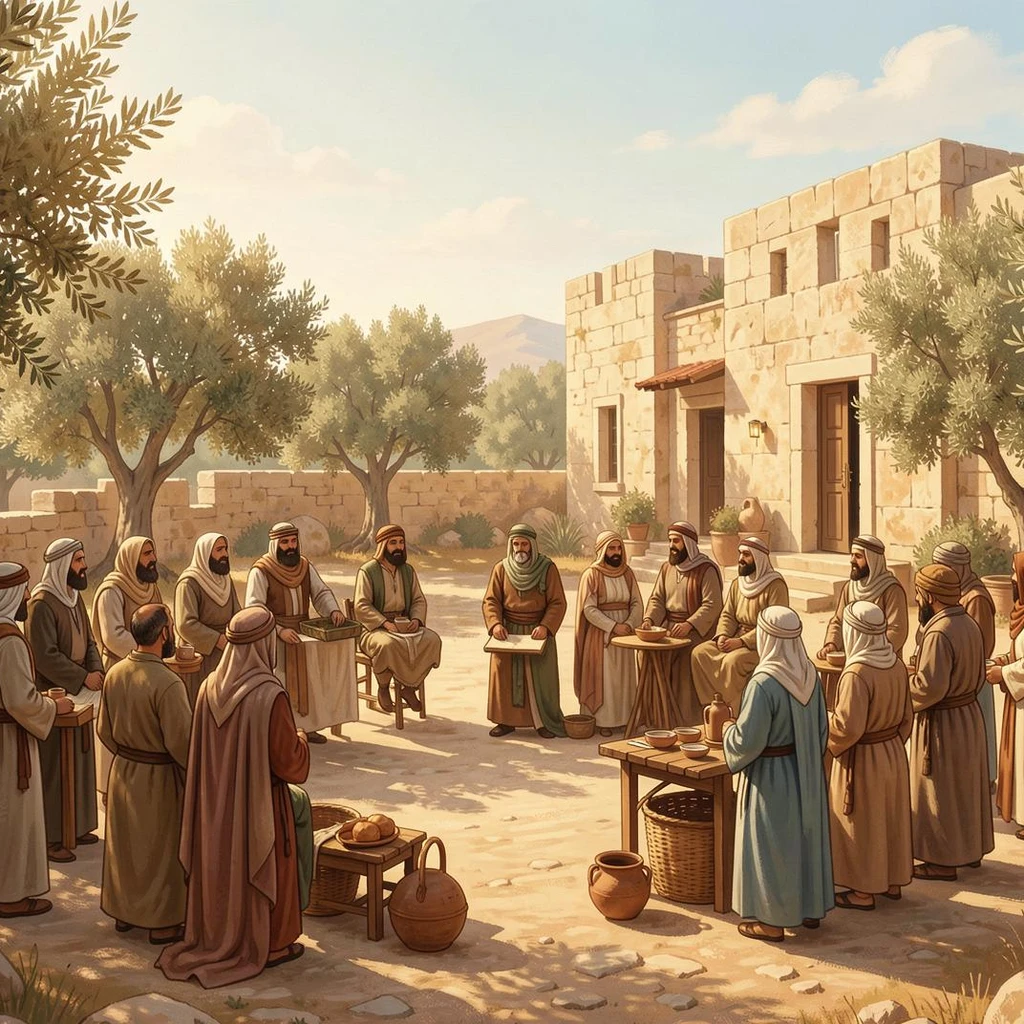
CHAPTER 11 — AUGUST 2031: BREAKTHROUGH
August 2031. Two years since the first attempt failed. One year since the circle began.
The grove had changed. Or maybe Tayeb was seeing it differently now.
The olive trees stood as always — silver-green leaves, gnarled trunks, roots gripping the limestone soil. The grove owner’s chair, the one his grandfather had sat in to watch the harvest, stood empty at the edge of the circle. But the circle was growing.
What had begun with nine young people under the trees had expanded. Twenty now. Sometimes thirty. But the growth had not been smooth.
April 2031. Tension within the circle. One of the members wanted to teach a specific political position — anti-government, oppositional. The others pushed back: “We teach the practice, not the position.” The argument lasted weeks. Eventually, the member left. Seven remained — but the disagreement had clarified something about what the circle was and wasn’t.
May 2031. The grandparents were fading. Youssef’s grandmother came less often, her health failing, her voice softer. Amira’s grandfather stopped coming entirely — his memory gone, his body failing. Time was taking the elders before the circle could receive what they carried.
June 2031. A breakthrough. Samira — the young woman whose grandfather had been a shaykh in a tariqa, who’d been coming since the first weeks — brought new dhikr formulas Tayeb had never heard. Practices that had survived in private, passed from father to daughter, hidden from the state for decades. She’d been holding them back, uncertain whether the circle was ready. Now she shared them. The circle grew — ten, twelve, fifteen — and deepened.
July 2031. The summer heat. The cicadas singing. The circle gathered in the early morning now, before the sun rose, to escape the heat. Twenty people. Sometimes twenty-five. They were no longer just seekers — they were practitioners. The dhikr was taking root. The relationships were forming. The circle argued about logistics, timing, what to teach, how to teach it — but the gathering held.
The growth was uneven. Two steps forward, one step back. Someone came, someone left. But the circle was finding its shape.
They gathered every Saturday. The grandparents came when they could — fewer now, time taking them one by one. Youssef’s grandmother still came, her movements slower, her voice softer, but the dhikr practice unchanged.
The young people led now. Youssef facilitated the dhikr. Malik organized the logistics — food, mats, scheduling. Amira documented everything — the practices, the stories, trying to systematize what survived.
Tayeb watched. He still didn’t lead. He still didn’t teach. But he was no longer just an observer. He was part of the circle. He sat under the olive trees, listened to the dhikr, watched the transmission happening in real time.
His notebook was full. He’d stopped taking notes.
The question that had driven him to Indonesia — What survives when networks assimilate state logic? — had haunted him through the pesantren courtyards, through the NU headquarters, through the waqf deeds room, through the Resolusi Jihad memorial, through the village evening meal. He’d watched the network transmit the state’s demographic logic — two children, modern, prosperous — and he’d wondered: What was the point of preserving the network if the network just transmits what the state wants?
The dhikr circle wound down. The chant faded into silence. Youssef’s grandmother opened her eyes, looked around the circle. The August heat still pressed, even in the shade — the limestone radiating warmth through the mats, the air thick with the smell of wild rosemary and dry earth. Her gaze passed over the young faces — students, workers, unemployed — sweating in the late afternoon.
“Practice,” she said. Her voice was soft, but it carried. “Tomorrow morning. 4:15 AM. Sahur before the first light.”
Some of the young people nodded. They knew the practice. Some looked confused — they were new.
“The predawn meal,” Youssef explained. “Before fasting. Before the first light. We wake. We eat. We practice dhikr. Like the pesantren in Indonesia. Like the zawiya before them.”
“Tunisia doesn’t have pesantren,” a new voice said — a young woman, nineteen, university student, drawn to the circle by word of mouth.
“We have this,” Youssef said. He gestured to the olive trees. “We have the grove. We have the practice. We have each other.”
“But who teaches?”
“We teach each other,” Youssef said. “The fragments my grandmother remembered, I pass to you. The stories Amira’s grandfather told, she documents. The practices we learned in private, we make public. The transmission is reestablished — not in institutions, but in relationships.”
The young woman was quiet. She was thinking. Her fingers moved on her knee — a small, unconscious gesture, the way Tayeb’s own fingers moved when something landed without settling.
“What transmits?” the young woman asked. “What do we pass to each other?”
Youssef didn’t answer immediately. He looked to his grandmother. She smiled — a small, weathered smile.
“We pass the practice,” she said. “Not the content.”
“The practice?”
She looked at the circle — the young people, the olive trees, the fading light. She looked at Youssef, her grandson, who had learned the dhikr at her knee.
“When I was a girl,” she said, “my grandfather taught me dhikr. He taught me the formulas. He taught me the rhythm. He taught me the movements. The specific words he taught — I don’t remember them all now. But the practice — the waking before dawn, the sitting in circle, the sound of many voices becoming one — that I remember. That I passed to Youssef.”
She paused. Her voice was weaker now, but the clarity remained.
“My grandfather taught differently than the imams teach now,” she said. “He sat with us — in the zawiya, on the mat, face to face. He listened to what we needed. He answered what we asked. Not what the state told him to answer. What we asked.”
“And the network?” Tayeb asked. He’d asked this question before, in Indonesia. But now he was asking it differently.
The grandmother nodded slowly.
“Thirty years ago,” she said, “the shaykh in our zawiya taught: have many children. God provides. My father had nine siblings. By the time I was grown, the shaykh was teaching something different — wait between children, for the mother’s health, for the family’s welfare. He’d changed his mind. He’d sat with the community, heard their struggles, and taught what the circumstances required.” She paused. “The shaykh’s teaching changed. But the way he taught — sitting with us, listening, deciding together — that never changed.”
Tayeb’s hand found his notebook. He didn’t open it. The question he’d carried since Indonesia — What survives? — sat differently now.
“My grandmother had a basket,” the old woman said. Her voice was softer now, the words coming slowly. “A woven palm basket, made by her own mother. She used it every day — carrying olives from the harvest, carrying bread from the oven, carrying vegetables from the garden. Whatever was in season, whatever was needed.” She looked at Tayeb. “The olives changed. The bread changed. The vegetables changed with the seasons. But the basket — the basket remained.”
She gestured to the circle around her. “What we carry inside it changes. Many children, when children are needed. Fewer, when health is needed. The cargo changes with the seasons. The basket remains.”
Tayeb was quiet. The grandmother’s words sat in his chest — the basket, the olives, the seasons changing.
“The shaykh could change his mind,” Tayeb said slowly. “The state can’t.”
“The state decides from above,” Youssef said. “The shaykh decided with us.”
“But we don’t have the shaykh anymore,” Amira said. “The state closed the zawiya.”
“We have my grandmother,” Youssef said. “We have what she remembers.”
“Is that enough?” the young woman asked.
Nobody answered immediately. The cicadas filled the silence.
“We don’t know,” Youssef said finally. “The basket my great-grandmother used — she didn’t know what she’d carry in it next season. She just carried.”
“But what do we carry?” the young woman pressed. “What’s our cargo? What is maslahah — the public good?”
“That’s for us to decide,” Youssef said. “Together. Over time.” He looked at his hands, then at the circle. “We don’t have the answer yet. We have the basket.”
The Mediterranean light slanted through the olive branches. The heat had broken. The evening breeze carried the smell of wild rosemary and limestone dust.
The First Deliberation — One Week Later
The circle gathered in the grove, twenty people sitting under the olive trees. The August sun was low, the limestone pale orange in the evening light. The mats were arranged in a wider circle now — they’d outgrown the small gathering of a year ago.
Youssef stood. “The circle has a question to deliberate.”
The group settled. The conversation died away. The silence grew — not empty, but full. Twenty pairs of eyes closed. Shoulders dropped. The cicadas seemed to fade, the evening breeze to still.
Tayeb’s palms rested on his knees. He’d felt this silence before — in the pesantren courtyard, in the village evening meal. But those were old rhythms, refined over generations. This was something else. Fragile. New. Barely formed.
The silence held for a full minute.
Then someone spoke — a young woman named Fatima, twenty-one, university student in literature. “We’ve been meeting for ten months. Practicing dhikr. Learning from the grandparents. Documenting fragments.” She opened her eyes, looked around the circle. “But we’re still invisible. The state doesn’t know we exist. The community doesn’t know what we’re doing. We’re hiding in the grove, practicing in private.”
She paused. “Should we remain invisible? Or should we become visible?”
The silence returned.
Tayeb watched the faces in the circle — some eyes still closed, some open, searching.
Another voice — Malik, twenty-seven, the organizer. “If we become visible, the state will notice. They may try to regulate us. They may try to co-opt us.”
A third voice — Amira, the sociologist. “If we remain invisible, we can’t grow. We can’t transmit. We can’t serve anyone except ourselves.”
The circle considered. No one interrupted. No one shifted or stirred. The silence held the question.
Then Youssef spoke. “The state cannot regulate what it doesn’t see. But the state cannot support what it doesn’t know.”
He paused. “We need to become visible to grow. We need to become known to transmit. But we need to become visible in a way that preserves our autonomy.”
Another silence. Longer this time. Two minutes. Three.
Then Fatima spoke again. “What if we become visible through service? What if we do something the community needs — something that shows our practice, demonstrates our capacity, invites participation without demanding it?”
“What kind of service?” someone asked.
“A community center,” Malik said. “Like the one we’ve been discussing. Built by the community, for the community. Not state-run. Not donor-funded. Built through collective labor, funded through pooled resources, governed through collective deliberation.”
“But we have no funding,” someone said.
“We have labor,” Youssef said. “We have skills. Tayeb is an engineer — he can design. Malik studied construction — he can organize. We have young people willing to work.”
“We need materials,” someone else said. “Stone, cement, roofing, tools.”
“Those can be acquired,” Malik said. “Gradually. Some donated. Some purchased. Some salvaged.”
The circle fell silent again. Considering.
Then the grandmother — Youssef’s grandmother, eighty-three years old, voice soft but clear — spoke for the first time. “The zawiya I attended as a girl — we built it together. The community contributed labor, materials, money. But not equally — each gave according to capacity, received according to need. This was takaful — mutual obligation, not charity.”
She paused. “The practice — the dhikr, the transmission — was part of the building. We built the zawiya by practicing together. The practice sustained the building. The building sustained the practice.”
Several people looked at each other. A few nodded slowly.
Then someone asked: “Where do we build it?”
“The grove,” Tayeb said. All eyes turned to him. “We have the land. The trees. The space. The building should be here — visible, accessible.”
He paused. “But it must serve the community. Not the state. Not an institution. A place where the community decides for itself.”
The circle considered this.
One by one, heads nodded. Not everyone — two people in the circle sat with arms crossed, faces uncertain. But most leaned forward. The agreement formed. The circle would build a community center. It would be visible. It would serve.
Youssef stood. “The decision is made. Malik will organize the labor. Amira will document the process. We will begin next week.”
The circle dispersed. Young people gathered their belongings, greeted each other, drifted away in pairs and small groups.
Tayeb sat alone under the olive trees. The limestone held the day’s heat against his palms. The Mediterranean darkened beyond the hills. The cicadas sang.
He closed his notebook. The olive leaves rustled in the evening breeze. The neighborhood mosque had announced three births this year. Five deaths.