CHAPTER 9 — MARCH 2029: FIRST ATTEMPT
Tunis, March 2029. Three months after returning from Indonesia.
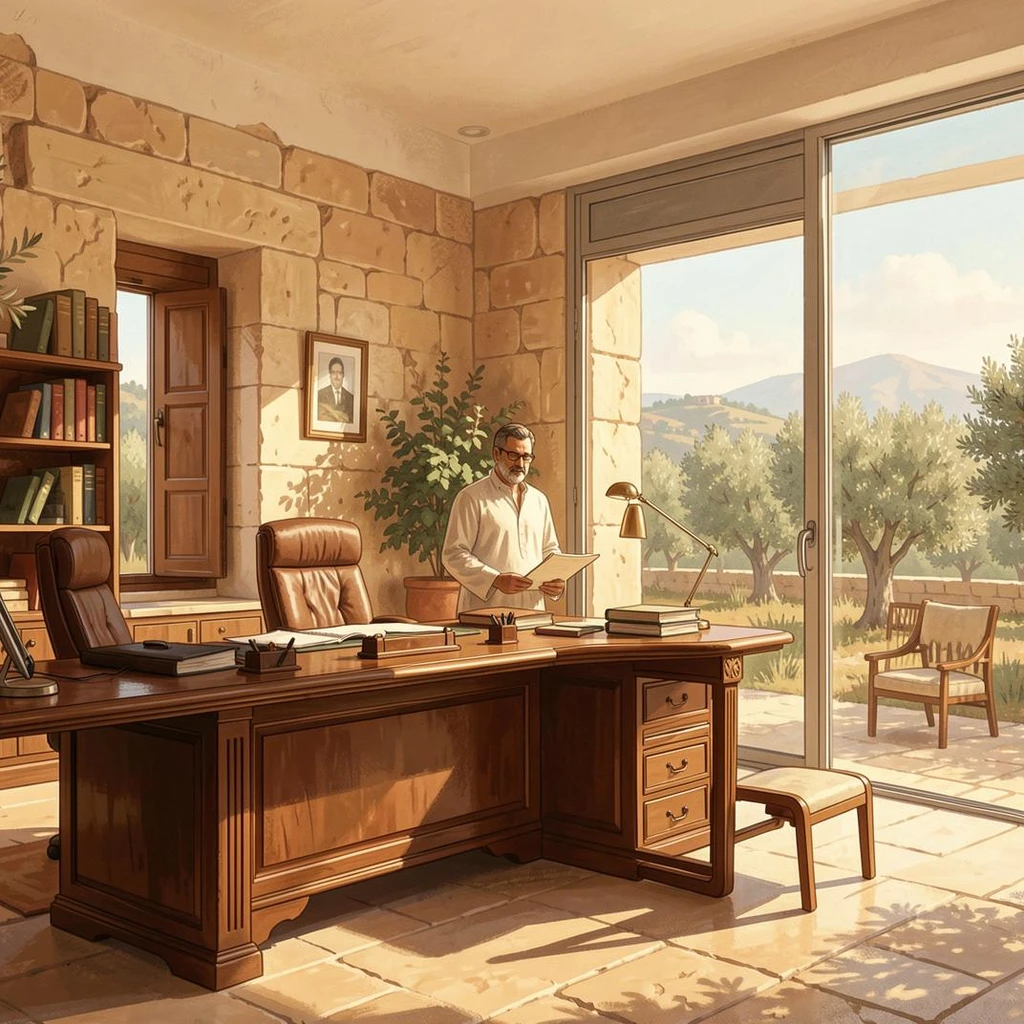
Tayeb’s office faced north, away from the sea, toward the olive groves of the Cap Bon peninsula. The light was different from Jakarta — not the flat equatorial white he’d lived under for twenty-six months but Mediterranean gold, slanting through the blinds at a low angle, dust motes drifting in the shaft. The air was different too. Dry. His skin had stopped itching within a week of returning. No humidity pressing against him like a second shirt. Just limestone dust and the faint salt of the sea three kilometers south.
He’d sat in this chair for twelve years before leaving. Now he sat in it again.
The Indonesia notebooks lay spread across the desk — seven leather-bound volumes, filled with observations. The seeds from Karangrejo sat in a pot by the window, planted in Tunisian soil four weeks ago. No sprouts.
He opened Volume 2, to the entry from October 2026 — the dhikr practice, the predawn chant, the transmission through the body, not through books.
The network preserved the capacity for collective decision-making, he’d written. The network enabled the community to decide for itself what is maslahah — what is the public good. The state decides for the community. The network enables the community to decide.
He’d spent three months trying to apply this.
He’d contacted everyone he could think of — scholars of Islam, historians of the zawiya, elders who remembered the habous system, imams who still taught the old ways. He’d convened meetings. He’d shown them the Indonesia model: Look, the networks survived there. They preserved autonomy.
The responses: a scholar checking his watch. An imam coughing into his fist. An elder who said, gently, Mr. Damerji, we are a modern republic. Why would we want to go back?
In January, he’d rented a community center in the medina. Posted flyers. Prepared a presentation — the notebooks, the mechanism, the model. Five people came. Two left before he finished speaking. The remaining three sat with arms crossed, and one of them said: Why should we listen to you? What makes you think you can bring back what’s gone?
He’d had no answer.
He’d tried a different approach. Economic independence. If he could rebuild the waqf — or something like it — the networks would have funding. If the networks had funding, they could operate independently.
He’d proposed a new endowment system — voluntary contributions, property held in trust, income funding community schools, mosques, charities. Not exactly waqf — the state had abolished that legal category — but something functionally equivalent.
He’d found investors. He’d drafted legal documents. He’d identified properties.
And then he’d taken the proposal to the Ministry.
The Meeting — February 2029
The Ministry of Religious Affairs occupied a beige building in Tunis, built in the 1970s, all concrete and fluorescent lights that buzzed at a frequency just below conscious attention. Tayeb sat in the waiting room for forty minutes. The chair was plastic, the walls bare except for a framed photograph of the president. A man in a jebba beside him flipped through a folder stamped with an official seal, not looking up.
The door opened. A secretary appeared.
“Mr. Damerji? Minister Belaid will see you now.”
The office was spacious, air-conditioned, with a window overlooking the parking lot. Minister Farid Belaid sat behind a mahogany desk — fifty years old, Western suit, Tunisian flag pin on the lapel. He didn’t stand.
“Mr. Damerji. Please sit.”
Tayeb sat. Placed his folder on the desk.
“The endowment proposal,” Belaid said. He didn’t open the folder. “I’ve reviewed it.”
“And?”
“It’s innovative.” Belaid shifted a pen on his desk, aligning it with the edge of a notepad. “Well-researched. The Indonesian material is… interesting.”
“It works,” Tayeb said. “The networks preserved their autonomy. They maintained economic independence. They kept the capacity to decide collectively.”
Belaid nodded slowly. He opened the folder. Turned a page. Turned another. Closed it.
“The legal framework here is different,” Belaid said. “Our endowment structures were reformed in the fifties. The habous system was… a different era.”
“It’s not waqf,” Tayeb said. “It’s a charitable trust. Voluntary contributions. Property held—”
“—outside state regulatory oversight,” Belaid said. The pen tapped once on the notepad. “Yes. I read the proposal carefully.”
“The communities lost their economic base when the habous was abolished,” Tayeb said. “Centralization, I understand. But they lost the ability to—”
“We’ve made significant progress since then,” Belaid said. His tone hadn’t changed — still polite, still measured — but something in his posture had closed. Shoulders squared. “The state provides religious services. Mosques, imams, education. The need for parallel structures… no longer exists.”
“The state provides services,” Tayeb said. “But the state can’t adapt. The state can’t—”
“The state evolves through democratic process,” Belaid said. He stood up. “Mr. Damerji. I understand the demographic concern. The TFR. The aging population. These are real challenges. But the solution lies in policy. Incentive structures. State programs.”
He walked to the door. Held it open.
“We’ll keep your proposal on file. Thank you for coming.”
Tayeb walked out through the fluorescent corridor, past the buzzing lights, past the man still waiting with his stamped folder. The afternoon heat struck him at the entrance — dry, white-gold, the air thin after Jakarta’s wet weight. Exhaust and dust and the faint salt of the sea. He walked toward Avenue Habib Bourguiba without looking back.
The asr call to prayer sounded from the Al-Zaytuna Mosque — a single voice, clear and solitary, not the layered canyon of Jakarta’s five mosques within earshot. One adhan, rising over the avenue.
He stopped. The mosque door was visible across the street — the same door his grandfather had walked through, the same door that had stood for centuries. Men emerged from the archway, carrying their prayer with them, walking back to work.
Tayeb continued toward the grove.
The Grove — Night, 2 AM
Tayeb couldn’t sleep.
The Ministry’s rejection turned in his mind — the pen aligned on the notepad, the polite smile, the door held open. So he walked the grove.
The olive trees stood in rows, silver-green in the moonlight. The night air was cool — March wind off the hills carrying limestone dust and wild rosemary. No humidity. No kretek smoke drifting from the fence line. No motorbike engines in the distance. Just the wind in the olive leaves and the occasional scrape of a branch against its neighbor.
He walked to the southern edge, where the family plot lay beneath the carob tree. His father’s grave. His grandfather’s grave. Cold stone under his fingers.
His grandfather had told him stories, before the memory faded. Not abstract stories — specific ones, rooted in things Tayeb could touch.
The waqf deed, his grandfather had said once, was written on paper that smelled like dust and lemon. I held it in my hands. The ink was brown, the calligraphy beautiful. The property — two olive groves, a mill, three shops in the souk — was endowed in perpetuity. Income every harvest. The money fed the students. Paid the teacher. Repaired the mosque roof. Every year, for three hundred years, until they took it.
His grandfather’s voice had gone quiet then.
1957, he said. They came with documents. Government documents. Signed by the president. Everything transferred to the Ministry. The groves. The mill. The shops. The students went home. The teacher found work in a factory. The mosque roof leaked for ten years before the state repaired it.
Then 1961, his grandfather continued. The police came at night. Not to the waqf office — that was already gone. To the zawiya. They arrested the sheikh. Padlocked the door. The building became a youth center. The dhikr circle — the one your great-grandfather led — stopped that night. Never resumed.
His grandfather had paused.
They said it was progress, he said. Each law separate. Each law presented as modernization. The waqf abolition: economic reform. The zawiya closure: religious reform. The marriage law: women’s rights. Who could argue with any of them, taken one by one?
His grandfather’s voice had dropped.
But together? he said. Together they cut the roots. Economic base. Institutional home. Community mediation. One by one by one. And when the roots were gone, the tree fell.
Tayeb stood at the family plot, his fingers on the cold stone. The carob tree creaked above him. His grandfather had not said: They knew what they were doing. His grandfather had said: The roots were cut. Whether the cutting was deliberate or accidental — the result was the same. The tree had fallen.
He struck the stone with his fist. Pain shot through his knuckles.
The grove was silent. The olive leaves rustled. The moon moved behind a cloud and the shadows deepened between the rows.
He stood at the family plot for a long time. The wind shifted, carrying the smell of the grove — olive leaf, limestone, dry earth. His grandfather’s trees. His grandfather’s grandfather’s trees. Still standing. Still rooted.
The Meeting — Zeitouna University — One Week Later
Tayeb stood before the assembled scholars. Five men, professors of Islamic law and history, white beards and traditional jebbas. They sat in a semicircle in the university’s conference room, beneath a portrait of Bourguiba.
The Indonesia notebooks were open on the table — Volume 2, Volume 3, Volume 4. Charts showing organizational structure. Photographs of dhikr circles. Maps of pesantren locations.
“The Indonesian model,” Tayeb said, “preserved what we lost. The networks survived. The pesantren continued. The waqf equivalent provided economic independence.”
He gestured to the photographs.
“These communities decided for themselves what is maslahah—the public good. They accommodated state policy without losing autonomy. They chose. They weren’t coerced.”
The scholars were silent.
Professor Hassan, the eldest, adjusted his glasses. His face was weathered, lined with decades of scholarship. He didn’t look at the photographs. He looked at Tayeb.
“Mr. Damerji,” Hassan said. “You’ve been to Indonesia. You’ve seen their institutions. This is… valuable comparative work.” He touched the edge of a photograph, sliding it slightly across the table. “But I’m not sure what you’re asking us to do with it.”
“Consider rebuilding,” Tayeb said. “The networks—”
“Rebuild what, exactly?” Hassan asked. Not hostile. Genuinely curious, the way a scholar is curious about a hypothesis he already considers flawed.
“Community structures. Economic independence. The capacity for—”
“The zawiya system,” Professor Mansour spoke up — younger, forty, Sorbonne PhD, the defensive tone of someone who’d studied in Europe and returned to find his country wanting. “You’re describing the zawiya system. With different terminology.”
“I’m describing what worked in—”
“In Indonesia.” Mansour nodded. “Which has a different history, a different legal framework, a different relationship between state and religion.” He gestured vaguely toward the window. “What grows in volcanic soil doesn’t transplant to limestone.”
Tayeb looked at him.
“It’s a good metaphor,” Mansour said. “You’re an engineer. You understand the science. pH levels. Drainage. Mineral content. The soil either supports the plant or it doesn’t. You can’t wish it into compatibility.”
“The soil here,” Hassan said, “is different. We chose a different path. You may think it was the wrong path. But it’s the path we took. And we can’t undo it by importing someone else’s roots.”
He stood up. The meeting was over.
“Mr. Damerji,” Hassan said. “The demographic situation concerns us all. The TFR. The aging. But the answer isn’t in the past, and it isn’t in Indonesia. The answer, if there is one, will have to grow from here.” He touched the table. “From this soil.”
Tayeb gathered the notebooks. Closed Volume 2. Closed Volume 3.
“So there’s nothing to learn?” he asked.
Hassan smiled — patient, not unkind. “Learn everything you can. But learn it as observation, not as blueprint. What Indonesia did, Indonesia did. What Tunisia needs, Tunisia will have to discover.”
Tayeb left the university. The afternoon light was white-gold, the Mediterranean spring warming the streets. He walked toward the medina, past the streets where the zawiya had stood, where the waqf offices had operated. The streets were still here. The mosques were still here. The people were still here.
The soil was different. The history was different. What grew in one place could not be made to grow in another by force of will.
Tayeb returned to his office. The light was Mediterranean—white-gold, slanting. The olive groves covered the hillsides beyond the window. His grandfather’s trees.
The door opened. Karim Ben Salem leaned in — thirty-four years old now, atlas_bridge’s lead engineer, Tayeb’s right hand. Karim had kept the company running while Tayeb was in Indonesia. Karim had known the real reason for the twenty-six months.
“How’s the rebuilding going?” Karim asked. The question was gentle.
Tayeb gestured at the notebooks spread across the desk. “I have the mechanism. I have the model. I have the proof that it works in Indonesia.”
“And?”
“And Tunisia is not Indonesia.”
Karim came into the office, leaned against the desk. “The waqf proposal was rejected?”
“Rejected. The Ministry says it’s too close to the old habous system. They won’t allow endowments outside state control.”
“And the university?”
“They say the soil is different. You can’t transplant volcanic networks to limestone.”
Karim was quiet. He picked up a pen from the desk, turned it between his fingers.
“The seeds?” he asked, gesturing to the pot by the window.
Tayeb looked at the pot. The soil was Tunisian—red, limestone-heavy, alkaline. The seeds were Indonesian—rice from Karangrejo, varieties that had grown in volcanic soil for centuries.
No sprouts. Three months, and nothing.
“Indonesian rice needs volcanic pH, 12-hour daylength, tropical humidity,” Tayeb said. “Tunisian soil is pH 8.0. Mediterranean climate. Variable daylength. The seeds have water and light, but their programming doesn’t recognize this environment.”
“They’re not growing,” Karim said.
“They’re not growing.”
Karim set the pen down. He looked at the pot, then at the notebooks, then at the olive groves beyond the window.
“The networks,” he said quietly. “They evolved here. The zawiya, the waqf, the habous — they grew from this soil, this history, this religion. They can’t be transplanted from Indonesia because they were never Indonesian.”
He paused.
“You’re trying to grow Indonesian rice in Tunisian soil. The seeds know. The soil knows.”
“The networks were destroyed,” Tayeb said. “There’s nothing left to rebuild. I’m trying to transplant something that has no roots.”
He stood up, walked to the window. The olive groves covered the hillsides, silver-green against the limestone. The trees his grandfather had tended. The trees his grandfather’s grandfather had planted.
“The trees survived,” Tayeb said.
“Because they grew from their own roots,” Karim said. “In their own soil.”
Tayeb turned back to him. “So what do we do? If we can’t rebuild, if we can’t transplant — what?”
Karim didn’t answer immediately. He looked at the pot. He looked at the notebooks. He looked at the olive groves.
“We don’t rebuild,” Karim said. “We don’t transplant. We plant something new.”
“Something new?”
“Something that can grow in this soil,” Karim said. “Something that has roots here. Something that belongs to this place.”
“But what?”
Karim shook his head. “I don’t know. But I know this: you’ve been trying to copy Indonesia for three months. The NU. The pesantren. The waqf. What worked there won’t work here.”
He paused.
“What survives here? What’s still here? What wasn’t destroyed?”
Tayeb thought about it.
The olive trees. The groves. The families. The mosques. The prayer.
The people.
“The people,” Tayeb said slowly. “The transmission is between people. Teacher and student. Elder and youth. Parent and child. The mechanism—pesantren, NU, waqf—that’s just the form. The substance is the relationship.”
“And relationships,” Karim said, “are not institutions. You can’t legislate them. You can’t endow them.”
“So how do we rebuild?”
“We don’t rebuild,” Karim said again. “We cultivate. You don’t rebuild an olive tree. You plant a seed. You water it. You wait.”
He gestured to the notebooks.
“Put them away,” Karim said. “They’re not a blueprint. They’re observations from another place.”
“You’re saying I wasted twenty-six months?”
“I’m saying you learned what doesn’t work,” Karim said. “Transplanting doesn’t work. Copying doesn’t work.”
“So what works?”
Karim smiled. It was a sad smile.
“That,” he said, “is what you have to find out.”
Tayeb looked at the notebooks. Seven volumes. Twenty-six months. He picked up Volume 2 — Pesantren Tebuireng. The dhikr practice, the predawn chant, the transmission through the body. He’d thought he could copy this. Bring it back. Make it grow.
He closed the notebook.
One by one, he closed them all. Volume 1. Volume 3. Volume 4. Volume 5. Volume 6. Volume 7. He stood at the bookshelf and placed them side by side — leather spines aligned, seven dark rectangles against the wood.
He turned back to Karim.
“Look at what’s here,” Karim said. “Not what was there. What survived? What’s still alive?”
Tayeb looked out the window at the olive groves. He thought of the cradles in his sister’s house, the ones that had held her children and now held nothing. He thought of his grandfather’s voice in the dark, telling him about the waqf deed that smelled like dust and lemon.
What can grow in Tunisian soil?
The question was different now. Not How do I copy Indonesia? But What grows from what remains?
The seeds in the pot by the window — Tunisian soil, red and dry, the Indonesian rice dormant beneath the surface. Neither sprouting nor rotting. Simply waiting.
Outside, the olive groves covered the hillsides, silver-green against the limestone. The Mediterranean light slanted through the blinds. Karim stirred his tea, the spoon clinking against the glass. The notebook lay closed on the table between them.
The wind moved through the grove. The olive leaves turned, pale undersides catching the light.